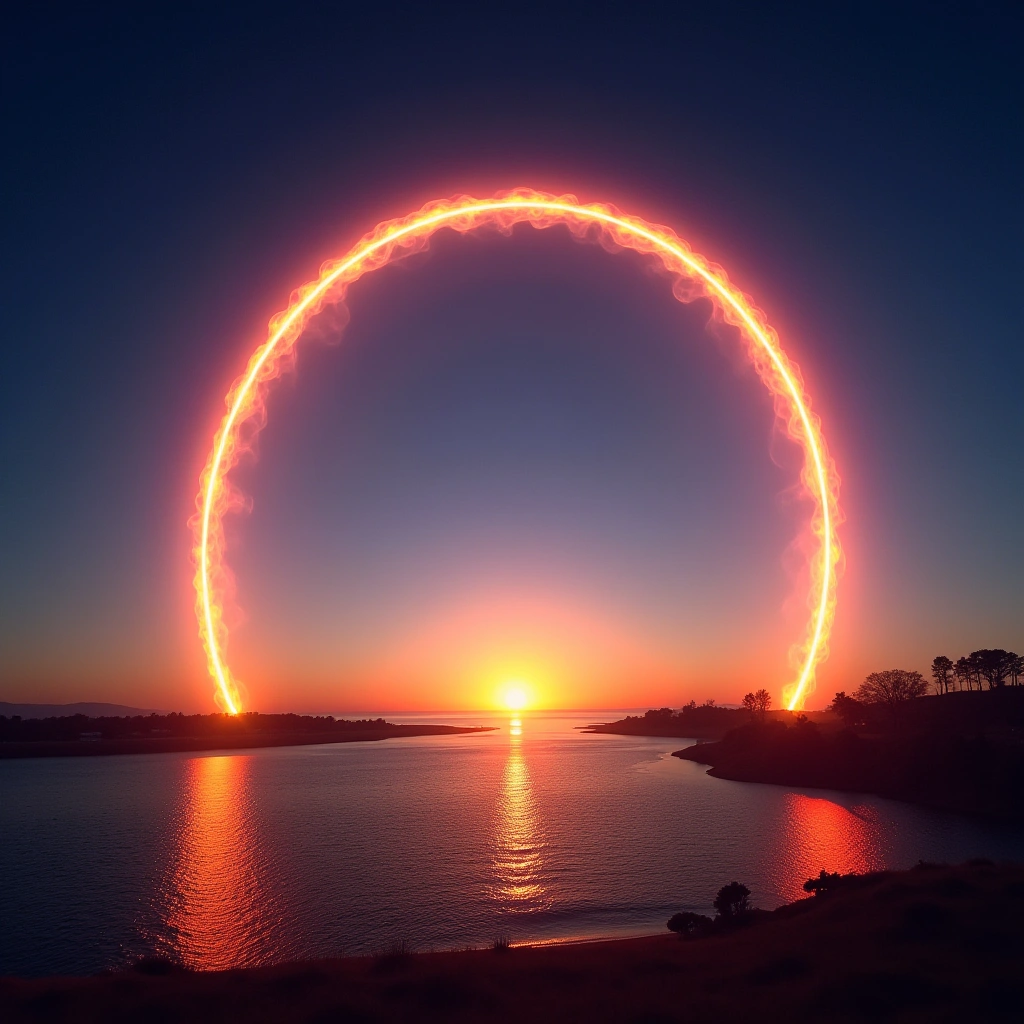
Hey there, fellow sky gazers! So, let’s talk about something that will have you questioning your everyday existence: fire rainbows! Yes, you heard that right. Not a rainbow made of flames (that would be a bit too ‘Game of Thrones’ for my taste), but a spectacular natural phenomenon known as a circumhorizontal arc. This isn’t just any old rainbow; it’s a rare celestial spectacle that was recently spotted by a hiker in the stunning mountains of Austria.
Related reading: The Magical Circumhorizontal Arc
Now, before you start picturing a bunch of leprechauns dancing around a pot of gold, let’s dive into the science behind this colorful beauty. A circumhorizontal arc occurs when sunlight refracts through hexagonal ice crystals found in high-altitude cirrus clouds. Imagine those ice crystals as tiny prisms, each one working hard to bend the light into a beautiful arc of colors. Who knew ice could be so colorful and artistic, right?
But hold on to your hiking boots, because this isn’t your average rainbow that shows up after a summer rain. Circumhorizontal arcs are rare, primarily because the conditions need to be just perfect. We’re talking about high-altitude cirrus clouds, which are often thin and wispy, and the sun has to be at a specific angle—around 22 degrees above the horizon. This means you’re more likely to see a unicorn riding a bicycle than catch a glimpse of this stunning arc on any given day.
So, what’s the deal with the name? “Circumhorizontal arc” sounds like something a wizard would cast in a spell, but it simply means “horizontal” because the arc sits parallel to the horizon. And let’s be real, who wouldn’t want to impress their friends with such arcane knowledge? Just drop it casually during a dinner party and watch the jaws drop.
Now, I can already hear some skeptics asking, “What’s the point of this colorful phenomenon?” Well, apart from the sheer beauty and the ‘wow’ factor, it serves as a reminder of how astonishing nature can be. It’s a bit like finding a hidden gem in a world full of mundane rocks. Plus, it’s a great excuse to go hiking and chase the skies. If you’re lucky enough to see one, consider yourself part of an elite club of sky-watchers. Just don’t forget to post it on Instagram with the obligatory hashtags, because let’s face it, if you don’t post it, did it even happen?
In conclusion, the circumhorizontal arc is not just a pretty face; it’s a dazzling display of nature’s artistry that requires a sprinkle of science and a dash of luck. So, the next time you’re out hiking, keep your eyes peeled for those high-altitude clouds. Who knows, maybe you’ll be the next lucky soul to witness a fire rainbow lighting up the sky! And if you do, make sure to take a moment to appreciate the sheer wonder of our universe—just you, the mountains, and a rainbow that’s way cooler than anything you could find in a box of crayons.
Inspired by: “Rare fire rainbow spotted by hiker in Austria, caused by sunlight refracting through hexagonal ice…” (r/interestingasfuck)