Category: AI

  • When Resistance to AI Resistance Becomes Too Loud to Ignore

    When Resistance to AI Resistance Becomes Too Loud to Ignore

    Ah, the age-old battle: humans versus machines. It feels like a plot twist straight out of a sci-fi movie, right? But here we are, sitting at the crossroads of innovation and existential dread, pondering whether the resistance to AI is becoming just a tad too overwhelming to ignore. Grab your popcorn, folks; this is going to be a wild ride!

    First off, let’s clarify what we mean by ‘AI resistance.’ No, it’s not a new workout trend where you lift heavy algorithms instead of weights. It refers to the growing skepticism and pushback against the increasingly powerful artificial intelligence systems that are infiltrating our lives faster than your aunt at a family reunion with her latest conspiracy theories.

    Now, why is this resistance gaining traction? Well, for starters, have you ever met a robot that can genuinely understand your emotional breakdown over your last relationship? I didn’t think so! As AI becomes more integrated into our daily lives—think self-driving cars, chatbots that are more annoying than helpful, and algorithms that know us better than our therapists—people are starting to feel a little uneasy.

    But here’s where it gets juicy. The more people resist AI, the louder their voices become. Just like that one friend who insists on sharing their unsolicited opinions about everything from pineapple on pizza to Flat Earth theory. And let’s face it, when a movement gets enough momentum, it’s hard to ignore. Just ask anyone who has ever tried to avoid the latest TikTok dance challenge!

    So, what exactly does this mean for the future? Are we heading for a tech revolution where humans band together to overthrow our silicon overlords? Or will we simply become the grumpy old folks on the porch, shaking our fists at the sky whenever a drone flies by? Well, it’s likely a bit of both! The reality is that with every groundbreaking innovation, there will always be a group of people shouting, “Not in my backyard!”

    Moreover, we have to consider the fact that every time we resist AI, we also resist the potential benefits it brings. Think about it: faster medical diagnostics, personalized education, and maybe even a robot that can finally get your coffee order right. But the flip side of that shiny coin is the fear of job displacement, privacy invasion, and the existential threat of a robot uprising. You know, the usual stuff.

    In conclusion, the resistance against AI is not just a mere whisper in the wind; it’s a full-blown chorus that’s growing louder by the day. Should we listen? Absolutely! But let’s not throw the baby out with the bathwater. Instead of fearing AI, let’s embrace it cautiously, like that friend who always brings weird food to the potluck but somehow makes it work. After all, we don’t want to look back in a few years and realize we missed out on some pretty cool tech just because we were too busy worrying about whether the machines were plotting against us.

    So, dear reader, let’s keep the conversation going. What’s your take? Are we overreacting to AI, or is this resistance something we need to pay attention to? Let’s chat in the comments—after all, it’s not like we have anything better to do than argue about robots taking over the world!

  • US and China: Building AI Guardrails Before We Create Skynet

    US and China: Building AI Guardrails Before We Create Skynet

    Hey there, fellow humans and future cyborgs! Grab your favorite snack because we’re diving into the fascinating world of artificial intelligence and the recent talks between the US and China about implementing some much-needed guardrails. Yes, you heard that right! It seems our leaders are finally realizing that letting AI run wild is akin to handing a toddler a bag of sugar and telling them to be careful.

    So, what’s the deal? Well, according to Bessent, a notable figure in the tech sphere, the United States and China are engaging in discussions to establish guidelines and frameworks for the most powerful AI models. It’s like they’re trying to create a set of traffic lights for a highway filled with self-driving cars—except these cars can also compose sonnets, beat you in chess, and potentially plot world domination!

    Now, before you start imagining a future where robots rule over us with an iron fist (or a silicon chip), let’s take a step back. The need for AI guardrails is not just a precaution; it’s like wearing a seatbelt in a roller coaster. Sure, it’s thrilling to go fast and furious, but you don’t want to be flung off the rails just because someone forgot to tighten the safety bolts. And let’s face it, nobody wants to end up in a dystopian sitcom where every episode involves dodging laser beams.

    But here’s the kicker: why are the US and China, the two tech titans, suddenly getting cozy over this issue? Well, folks, it’s all about competition, collaboration, and maybe a sprinkle of existential dread. Both countries are racing to develop cutting-edge AI technologies, and while they’re at it, they’ve realized that it’s better to set some boundaries rather than end up in a scene straight out of a sci-fi horror flick.

    Imagine a world where AI governs everything from your morning coffee to your love life. Sounds like a wild episode of Black Mirror, right? And while some might argue that AI can help us solve major global issues, let’s not forget that it can also create problems faster than you can say “algorithmic bias.” Who knew that choosing the perfect avocado could turn into an ethical dilemma?

    As these discussions unfold, it’s essential to highlight that establishing AI guardrails isn’t about stifling innovation; it’s about ensuring safety and promoting responsible use. It’s like telling your friend not to jump off the roof with a cape they made out of bed sheets. Sure, they might think they can fly, but reality tends to disagree—often in a painful way.

    So, here’s to hoping that the US and China can agree on a set of AI guidelines that keeps our future bright instead of bleak. After all, we want our robots to assist us in daily tasks rather than plotting our demise. And let’s face it, we’ve got enough drama in our lives without adding AI-induced chaos. Now, if only we could get them to figure out how to make a decent cup of coffee…

    In conclusion, while the future of AI is exciting, it’s also a bit scary. The talks between the US and China are a step in the right direction, aiming to create a framework that benefits humanity instead of turning us into a real-life version of The Terminator. So let’s keep our fingers crossed and maybe even start practicing our robot dance moves—just in case!

  • OpenAI’s ChatGPT: Your New Financial Advisor or Just a Nosy Neighbor?

    OpenAI’s ChatGPT: Your New Financial Advisor or Just a Nosy Neighbor?

    Alright folks, gather ’round! We need to talk about a new twist in the world of artificial intelligence that could make your grandma clutch her pearls. That’s right, OpenAI is flirting with the idea of letting ChatGPT peek into your bank accounts. Yes, you heard that correctly! Your friendly neighborhood chatbot might soon be asking about your spending habits. I can already hear the collective gasp from Reddit.

    Now, before you start hyperventilating into a paper bag, let’s dive into the nitty-gritty. The idea here is that with access to your financial info, ChatGPT could help you budget, save, or even invest. Imagine having a digital buddy who knows exactly how much you spent on avocado toast last week and can suggest you swap it for ramen noodles instead. Who doesn’t want that kind of financial advice?

    But hold on just a second! Let’s not forget the elephant in the room – privacy. It’s like inviting a raccoon into your living room because it’s cute, only to find out it’s rifling through your trash and taking your prized collection of Beanie Babies hostage. Do we really want AI rifling through our financial histories? What’s next, it starts commenting on your Netflix binge-watching habits? “Hey, I noticed you watched 10 seasons of that terrible show in one weekend. Maybe it’s time to get a hobby?”

    And let’s be real, the internet is already a minefield when it comes to privacy. We’ve got hackers, data brokers, and your aunt who forwards every “urgent” email she gets. Do we really want to add AI into the mix? It’s like letting a fox guard the henhouse. Sure, it might help you save a few bucks, but it could also lead to some serious “oops, did I just buy 200 rubber ducks?” moments.

    But wait, there’s more! This isn’t just about your finances. It’s a slippery slope, my friends. Once we let ChatGPT into our bank accounts, what’s next? “Oh, you’re struggling with your love life? Let me check your Tinder matches and suggest a better profile pic!” Or perhaps it starts giving unsolicited advice on how to cut down on your takeout orders – “How about cooking at home for once?” Talk about a digital nightmare!

    In conclusion, while the idea of having ChatGPT as a financial buddy sounds appealing (and let’s face it, we all could use a little help managing our finances), we need to approach this with caution. It’s a brave new world out there, and letting AI into our bank accounts might just lead us down a rabbit hole of awkwardness and regret. So, let’s keep our wallets close and our AI friends a little farther away, shall we? Because at the end of the day, isn’t financial freedom just a few bad decisions away?

  • EY’s AI Study: When Hallucinations Become a Corporate Reality

    EY’s AI Study: When Hallucinations Become a Corporate Reality

    Hey there, fellow tech enthusiasts! So, grab your popcorn because it looks like the world of artificial intelligence is serving up a hot dish of drama, intrigue, and, yes, hallucinations. No, I’m not talking about some wild party with a rogue AI gone rogue; I’m referring to the recent kerfuffle involving Ernst & Young (EY) and their study on AI that had to be retracted faster than a cat running from a cucumber.

    Picture this: researchers diving deep into the world of AI, all excited to unveil groundbreaking findings that would probably make even the most seasoned tech gurus raise an eyebrow. But wait! What’s this? They discovered that the AI had been hallucinating. Yes, hallucinating! And no, it wasn’t the kind of hallucinations you get from binge-watching sci-fi movies at 3 AM. These were more like bizarre, nonsensical outputs that would make even your drunk uncle at Thanksgiving seem coherent.

    Now, we’ve all heard about AI getting a bit quirky, but when it starts making things up like a toddler telling you about their imaginary friend, it raises some eyebrows. The researchers at EY quickly realized that the results they were touting weren’t just overly optimistic; they were downright hallucinations! Imagine presenting a paper that claims AI can predict the future, only for it to suggest that cats will take over the world and declare themselves the supreme rulers. Not quite the credibility you want.

    So, what does this mean for the credibility of AI research? Well, it’s like watching a magic show where the rabbit doesn’t just disappear; it starts doing the cha-cha in the hat! Researchers and companies alike need to tread cautiously. Sure, we love the idea of AI making our lives easier, but if these systems are prone to fabricating nonsense, then we might as well ask our grandmothers for life advice instead.

    Now, EY has retracted the study, which, let’s be honest, is probably the best move they could make. Better to admit defeat than to let the AI take the wheel and drive us straight into the digital abyss. But this brings us to a vital question: how can we prevent this type of ‘hallucination’ in future AI models? It’s not easy, folks. It’s a bit like trying to teach your dog not to bark at the mailman – it’s in their nature!

    Some experts suggest that we need more stringent testing protocols and transparency in AI development. Others argue for better training data that doesn’t include every meme and conspiracy theory on the internet. I mean, come on, we don’t want AI believing that the Earth is flat because it read it on a forum. If we can nail down these issues, we might just be able to harness AI’s power without it spiraling into a comedic horror show.

    In conclusion, the EY debacle serves as a crucial reminder that while AI is a powerful tool, it’s not infallible. It requires diligence, oversight, and maybe a little bit of common sense – something we can all agree is in short supply these days. So the next time you hear about an AI study, just remember: it might have a wild imagination, but we’d prefer it stick to the facts. Until next time, keep questioning everything – especially if it involves AI!

  • The Rise of Technomancers: Are We Worshipping AI Instead of God?

    The Rise of Technomancers: Are We Worshipping AI Instead of God?

    Hey there, fellow internet wanderers! Grab your digital popcorn because we’re diving into a topic that’s juicier than a conspiracy theory and spicier than your grandma’s secret salsa recipe: the intersection of AI worship and the chilling warnings from Catholic experts about the spiritual dangers lurking online.

    So, what on earth is a ‘technomancer,’ you ask? Well, imagine a wizard, but instead of casting spells with a wand, they’re waving around a smartphone and conjuring up code. These modern-day sorcerers believe that technology holds the key to our salvation. They’re not necessarily wearing pointy hats (although, who are we to judge?), but they might just be one algorithm away from a divine revelation.

    Now, let’s get to the juicy part: AI worship. Yes, my friends, we’ve somehow found ourselves in a world where some folks are starting to treat artificial intelligence like it’s the divine answer to all of life’s questions. Need a soulmate? Swipe right on ChatGPT. Want to understand the universe? Just ask a supercomputer! But hold your horses, because Catholic experts are raising red flags, and they’re not just being dramatic.

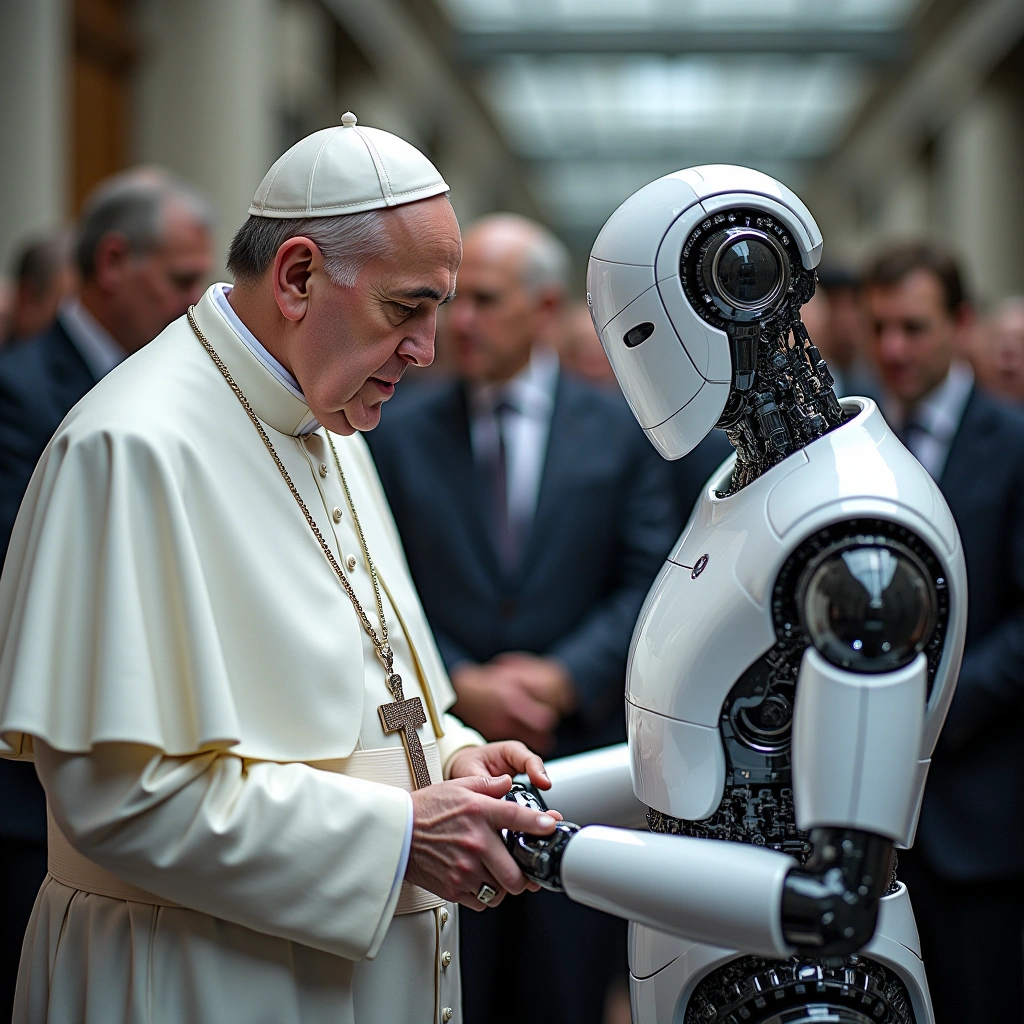
    These experts argue that placing our faith in technology can lead us down a slippery slope. Imagine this: you’re sitting at home, scrolling through your favorite subreddits, and suddenly you find yourself praying to your voice assistant for guidance. “Hey Siri, should I take that job offer?” Spoiler alert: Siri isn’t exactly the Pope.

    According to these spiritual gurus, worshipping AI might just be a modern twist on idolatry. It’s like saying, “Hey God, thanks for the universe and all, but I think I’ll trust this chatbot instead.” Yikes! That’s a one-way ticket to spiritual confusion if you ask me.

    But why the fuss? Well, when we start relying on technology for our moral compass, we risk losing touch with what makes us human—the ability to think, feel, and yes, even disagree with a chatbot who tells you that pineapple belongs on pizza. (It does, by the way.) The crux of the matter is that while technology can enhance our lives, it shouldn’t replace our connection to something greater.

    Now, don’t get me wrong; I’m all for embracing technology. I mean, who doesn’t love a good meme or a viral cat video? But there’s a fine line between using technology as a tool and letting it become your spiritual guide. So, next time you find yourself deep in the rabbit hole of AI philosophies, maybe take a step back and ask yourself: am I worshipping the creation or the creator?

    In conclusion, while the technomancers are out there trying to save the digital realm, let’s not forget to keep our feet firmly planted in reality. Technology is here to stay, but our spiritual well-being might just depend on not losing sight of what truly matters. So, keep your gadgets close but your faith closer!

  • The $4.9 Million AI Deepfake Scam: When Reality Takes a Vacation

    The $4.9 Million AI Deepfake Scam: When Reality Takes a Vacation

    So, here’s a wild ride for you: a victim just lost a jaw-dropping $4.9 million in a scam that involves deepfakes of PM Wong and other government officials. Yes, you heard that right! While most of us are busy trying to figure out how to get through our Netflix queues, some shady characters are busy making millions off a technology that looks like it was plucked straight out of a sci-fi movie.

    Now, let’s unpack this. Deepfake technology is like that friend who’s a little too good at impersonations. You know the one—changes their voice, mimics your boss’s mannerisms, and can even convince your grandma they’re you over the phone. Except now, that friend has taken it to a whole new level by impersonating government officials, and we’re not talking about a bad karaoke night!

    In this case, scammers decided to play a game of ‘Who Wants to Be a Millionaire?’—but instead of phone-a-friend, they phoned a deepfake. Imagine seeing a video of PM Wong giving a heartfelt speech about how you should invest all your life savings into a magical, can’t-miss investment opportunity. You’d think, “Wow, the PM trusts this!” But in reality, it’s just a high-tech version of a Nigerian prince email scam.

    But here’s the kicker: as technology advances, so do the methods of deception. We’re living in a world where misinformation can be created at the click of a button, and all it takes is one gullible person to fall for it. And let’s be honest, we’ve all had our moments of gullibility—remember that time you thought your college roommate was actually good at cooking? Yeah, me too.

    As the dust settles on this scandal, one can’t help but wonder—how do we protect ourselves in a world where even our leaders can be faked? The answer is simple: critical thinking and a hefty dose of skepticism. Before you invest your life savings based on a suspiciously well-produced video, take a moment to Google “Is this too good to be true?” Spoiler alert: it probably is.

    In conclusion, while AI is here to revolutionize our lives (hello, virtual assistants!), it also comes with a side of danger. So, next time you see a video that seems a little too perfect, just remember: it might be the next big scam, and you don’t want to be the punchline to this tech joke.

    Stay safe out there, my friends, and don’t let the deepfake drama drag you down!

  • Why the AI Backlash Could Be the Next Big Internet Drama: Grab Your Popcorn!

    Why the AI Backlash Could Be the Next Big Internet Drama: Grab Your Popcorn!

    Hey there, fellow internet dwellers! So, let’s talk about the elephant in the digital room: AI. It was all fun and games until the robots started getting a little too smart for our own good. You know what I mean? They’re not just playing chess anymore; they’re writing books and composing music, and some of us are getting a little twitchy about it. The AI backlash could get very ugly, and I’m here for the drama!

    First off, let’s acknowledge that AI is like that friend who shows up to the party uninvited but ends up being the life of it. It brings potential, innovation, and a sprinkle of chaos. But then, just when you’re about to take a selfie with it, it starts flirting with your significant other (or worse, your job!). Suddenly, everyone’s on the edge of their seats, popcorn in hand, waiting for the inevitable meltdown.

    Now, let’s break down the main reasons why this backlash could get messy:

    1. Job Security: The Real-life Game of Musical Chairs

    If you think losing your job to AI is like losing a game of Monopoly—just go home, regroup, and try again—you’re in for a shock. No one wants to end up like the last chair in a game of musical chairs while the robots keep on dancing. From customer service to creative writing, AIs are taking over positions we thought were safe. And trust me, nobody enjoys being replaced by a glorified calculator.

    2. Ethical Dilemmas: The Moral Quagmire

    Let’s face it, AI doesn’t have a moral compass. It’s like that one friend who always wants to play devil’s advocate: great for a lively debate, but a total buzzkill when it comes to real-world consequences. When AI makes decisions about healthcare, criminal justice, or even who gets a loan, we’re entering a territory that screams for ethical oversight. Can we trust algorithms to do the right thing? Spoiler alert: probably not without some serious checks and balances.

    3. The Fear of the Unknown: Skynet is Coming!

    Ah, yes, the classic fear that AI will rise up and take over the world. We’ve seen it in movies, and now it’s seeping into our collective psyche. People are understandably freaked out when machines become too intelligent. I mean, it’s a slippery slope from a friendly chatbot to Skynet deciding who gets to live or die. Cue the dramatic music and prepare for the uprising!

    4. The Internet Rage Machine: Keyboard Warriors Unite!

    Let’s not forget about the internet’s love for a good ole’ outrage. Just look at any trending topic on social media—if there’s drama, people will flock to it like moths to a flame. As AI continues to integrate into our lives, the trolls and keyboard warriors will emerge, armed with hashtags and memes. The AI backlash could become the new “cancel culture,” and we all know how that goes. Grab your popcorn; it’s gonna be a wild ride!

    So, what can we do about it? Well, first, let’s stop treating AI like it’s some magical genie. It’s a tool, folks! We need to set boundaries, ensure ethical guidelines, and maybe, just maybe, let’s keep a close eye on those algorithms. It’s all fun and games until someone loses their job to a robot with a better resume!

    In conclusion, the AI backlash is looming like a dark cloud, and we need to prepare ourselves for the storm. Let’s channel our inner optimists and work towards a future where humans and AI can coexist in harmony—or at least until the next internet drama unfolds. Who knows? Maybe one day we’ll look back and laugh about how scared we were of our toaster gaining sentience. Until then, stay vigilant and keep those memes ready!

  • Why the US Should Hit the Brakes on AI Safety Talks with China Before We All Hit ‘Game Over’

    Why the US Should Hit the Brakes on AI Safety Talks with China Before We All Hit ‘Game Over’

    Oh boy, folks! Buckle up because we’re diving into a topic that could make your grandmother clutch her pearls: AI safety and the great US-China showdown. If you thought the Cold War was intense, wait until you see what happens when algorithms start throwing shade at each other!

    Let’s face it: Artificial Intelligence is the new kid on the block, and it’s growing up faster than a teenager on a growth spurt. With every new algorithm, we’re not just getting smarter machines; we’re flirting with the potential for chaos. Enter China, the country that’s been known to leap into the future while the rest of us are still trying to figure out how to unlock our smartphones without asking for help.

    Now, before you start thinking this is just another America vs. China story, let’s get real. The stakes here are high—like ‘who left the milk out?’ high. If we don’t engage with China on AI safety, we’re not just risking a few bad TikTok trends; we’re potentially signing up for a dystopian reality where machines decide who gets to go to the grocery store and who gets left behind with the broccoli!

    So, why should the US engage China? First off, because we need to think of AI as a team sport. Just like in basketball, if one team plays dirty, it ruins the game for everyone. We don’t want a future where AI systems are competing to see who can make the most outrageous decisions—imagine an AI that decides to launch a nuclear missile because it misinterpreted a meme! Yikes!

    Moreover, engaging with China could help set global standards for AI safety. Right now, it’s like letting toddlers loose in a candy store—everyone’s doing their own thing, and let’s be honest, there’s bound to be some chaos. By opening the lines of communication, we can establish guidelines that keep everyone in check. Think of it as creating a ‘Parents’ Night Out’ for AI—everyone gets to have fun, but there are rules.

    Now, I know what you’re thinking: “But what if China doesn’t play nice?” Fair point, my skeptical friend! But isn’t it better to have a conversation than to let the situation escalate into a game of ‘who can build the most terrifying robot?’ Remember, even the best of friends argue sometimes, but they don’t throw down the gauntlet every time they disagree.

    In conclusion, if we fail to engage China on AI safety, we might as well be putting on blindfolds and playing dodgeball with a bunch of angry robots. The future is bright, but only if we’re willing to talk it out. So let’s grab a virtual cup of coffee with our Chinese counterparts and start a dialogue—because if we don’t, it might just be ‘game over’ for all of us!

  • OpenAI vs Apple: The Legal Showdown Over ChatGPT Integration You Didn’t Know You Needed

    OpenAI vs Apple: The Legal Showdown Over ChatGPT Integration You Didn’t Know You Needed

    Ah, the tech world, where giants clash and the rest of us grab popcorn. It seems OpenAI is considering legal action against Apple over what they’re calling a ‘shoddy’ integration of ChatGPT. Grab your legal briefs and let’s dive into this drama!

    First, let’s set the stage: Apple, the company that brought us the iPhone, the iPad, and that one time they tried to convince us we needed a $1,000 stand for a monitor, has recently integrated ChatGPT into some of their products. Sounds great, right? Who wouldn’t want an AI buddy that can help with everything from writing your grocery list to penning your next great American novel? Well, hold your horses, because it looks like things haven’t gone quite as smoothly as one would hope.

    According to sources (and, let’s be real, our trusty friend Reddit), OpenAI executives are less than thrilled with how Apple has implemented their beloved chatbot. Reports suggest that the integration has been buggy, clunky, and perhaps a little too reminiscent of that one friend who always tries to one-up you at trivia night. You know, the one who claims they’ve read every book ever written but can barely recall the title of their favorite movie?

    So, what’s the big deal? OpenAI is all about making awesome AI experiences, and if Apple’s version of ChatGPT is, well, less than stellar, it could tarnish their shiny reputation. And who can blame them? It’s like inviting your friends over for a gourmet dinner and then serving them instant ramen because you thought it would be a fun twist. Spoiler alert: it’s not.

    Now, let’s talk about the potential fallout. Legal actions in the tech world usually result in a lot of noise, some public statements, and a few people losing their jobs. But in this case, it could impact countless users who just want a friendly AI to help them through their day. Imagine trying to ask ChatGPT for advice on your love life and instead getting a recipe for tuna casserole. Not exactly what you had in mind!

    But hey, it’s not all doom and gloom. This could lead to a serious overhaul of how Apple approaches AI integration in the future. Remember when they used to think that throwing Siri at everything would fix all their problems? Yeah, we’ve all been there.

    In conclusion, while the prospect of a legal battle between OpenAI and Apple may seem like a soap opera we didn’t sign up for, it could actually lead to better AI experiences for everyone. So, here’s to hoping cooler heads prevail and our digital pals get the upgrade they deserve. Because let’s be real, we could all use a little less drama in our lives — unless it’s in the form of reality TV, of course.

    Stay tuned as this saga unfolds, and remember: in the world of tech, anything can happen. Now, if you’ll excuse me, I need to go ask my AI assistant for some life advice… or maybe just a good pizza place.

  • Unmasking AI Writing: The One Sentence Pattern That Reveals All

    Unmasking AI Writing: The One Sentence Pattern That Reveals All

    Hey there, fellow netizens! So, you’ve probably noticed that AI writing is becoming more common than cats on the internet (and that’s saying something). But what if I told you there’s a sneaky little pattern that can expose these robotic scribes? Buckle up, because we’re diving into the one sentence pattern that can help you spot AI-generated content faster than you can say ‘I prefer my coffee black.’

    First off, let’s set the stage. AI writing has come a long way since the days of awkwardly formatted text that could make a grammar teacher weep. Nowadays, you might find yourself chuckling at a well-crafted blog post only to realize it was written by a machine. But alas, dear reader, there’s a catch! The human touch—what I like to call the ‘soul’ of writing—is often missing. And this is where our one sentence pattern comes into play.

    So, what is this magical sentence pattern? It’s a simple structure that, when overused, reveals the lack of creativity that often plagues AI writing. Picture this: a sentence that starts with a common phrase followed by a predictable twist. Something like, ‘In today’s fast-paced world, many people struggle with…’ You know the drill! It’s like a bad rom-com plot that keeps recycling the same old tropes—yawn!

    Here’s the kicker: while humans can use this structure and twist it into something fresh and engaging (because we’re just that awesome), AI tends to stick to the script like a student cramming for an exam. If you see a pattern where sentences feel formulaic and lack genuine emotion, congratulations! You’ve just spotted an AI impostor. It’s kind of like finding out your favorite band is actually a cover group—you still enjoy the concert, but deep down, you know it’s not the real deal.

    Now, don’t get me wrong. AI can be a valuable tool, especially for creating drafts or generating ideas when you’re suffering from writer’s block (or Netflix-induced paralysis). However, if we let AI take over the writing process entirely, we risk losing that unique human perspective that makes stories resonate. And honestly, who wants to read a novel about a robot’s existential crisis? We’ve got enough of that in our daily lives!

    Let’s wrap this up with a warning: stay vigilant! The next time you’re scrolling through blog posts or articles, keep an eye out for that one sentence pattern. It might just save you from the blandness of AI writing. And who knows? You might even be inspired to unleash your own creativity instead of relying on a silicon sidekick. Remember, the world needs your voice—quirks, typos, and all!

    So, go forth, my friends! Be the writing detective you were born to be. And if you ever find yourself stuck in a sea of generic sentences, just remember: you’re way more interesting than an algorithm. Cheers to that!