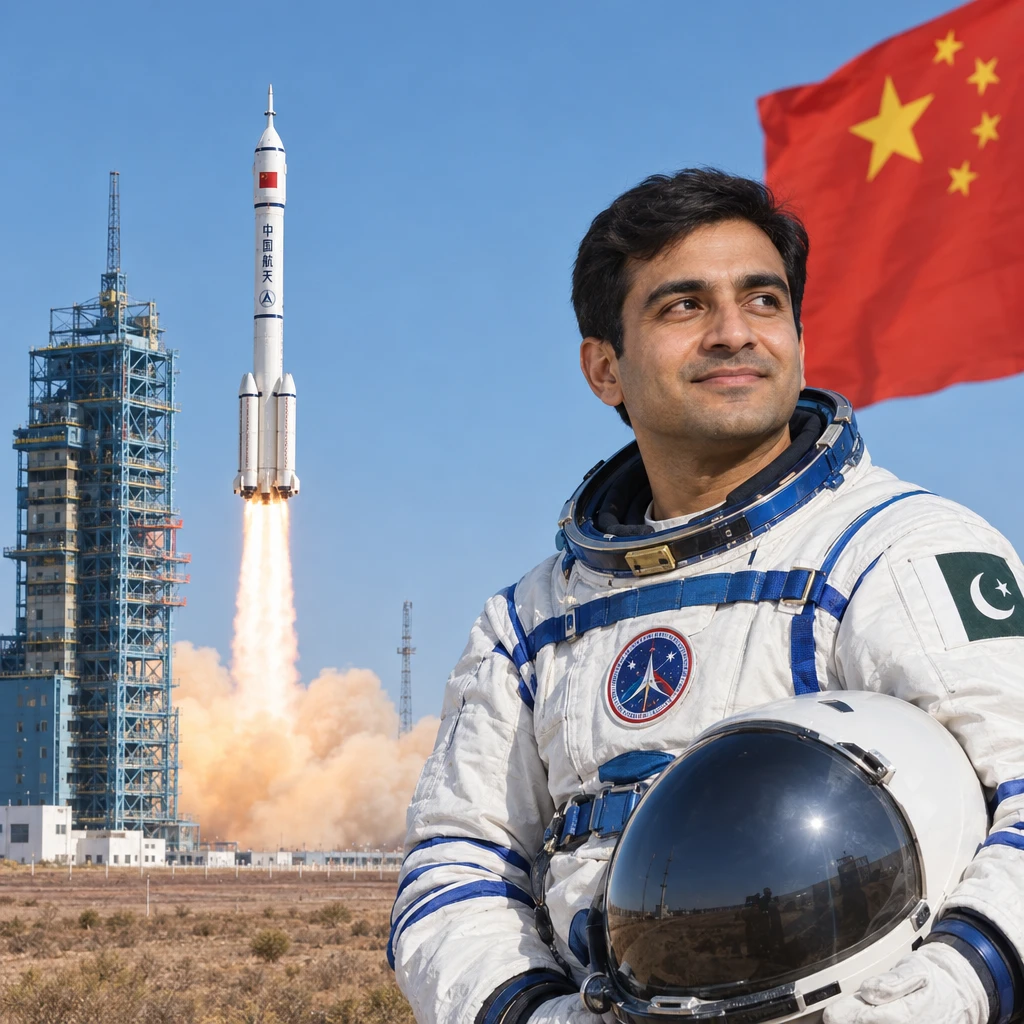
China has launched its Shenzhou-24 space mission today to bring three astronauts to its Tiangong space station, including a Pakistani man · Pakistan's Muhammad Zeeshan Ali will be the first foreign national to board the Tiangong space station.
Wednesday morning, China’s Shenzhou-24 spacecraft lifted off from the Jiuquan Satellite Launch Centre, and with it went something new for the country’s space program: its first foreign astronaut heading to the Tiangong space station. Pakistan’s Zeeshan Ali is the passenger in question, and if you have ever wondered what it feels like to be the guest of honor at a very exclusive party 400 kilometers above Earth, he is currently finding out.
The launch was carried out on a Long March-2F rocket, a workhorse of China’s crewed flight program. It has been used for many of the country’s human spaceflights, which makes it a reliable choice for a mission that is clearly meant to be taken seriously. Nobody wants a surprise on the way to the space station, least of all the people strapped to the top of the rocket.
Ali is expected to join a crew that already includes astronauts from mainland China and Hong Kong. Reports describe the mission as lasting somewhere between five and ten days, during which the crew will carry out experiments aboard Tiangong. Short missions like this are common for station visits, where the goal is usually focused research rather than a long stay. Still, a week or so is more than enough time to float around, admire the view, and get very good at tying things down.
It is worth noting that coverage of the flight does not agree on the exact makeup of the crew. Some reports count three astronauts, others describe a larger group, and the headline refers to two Chinese astronauts plus a Pakistani one. Space agencies do not always release every detail at once, and it is a good idea to check official statements as they come out before treating any single headcount as final.
Why does this matter? Because the mission marks a shift. For years, China’s crewed program was largely a domestic affair, with Chinese astronauts flying Chinese spacecraft to a Chinese station. Bringing in a foreign astronaut signals that Beijing wants Tiangong to be more than a national symbol. It is a platform for international collaboration, and Pakistan’s participation gives that idea a very real face.
For Pakistan, the flight is a milestone. Having a national aboard a station flight is a point of pride, and it opens doors for future scientific cooperation, training, and perhaps a few more ambitious missions down the line. It is hard not to be impressed by the idea of a country going from ground-based space ambitions to a crew member floating in orbit in a relatively short span of time.
So, while the experiments will get most of the attention in the weeks ahead, this launch is about something larger than lab work. It is about who gets to go to space, and how that circle is slowly getting wider. Keep an eye on the updates from the mission. If the crew comes home on schedule, expect this flight to be remembered as the moment Tiangong officially opened its doors to the world.
Inspired by: “China launches Shenzhou 24 spacecraft carrying 2 Chinese and a Pakistani astronaut” (r/News)