Huang, and the United States needed Nvidia, to “ensure the Success and Prosperity of not only the Company, but the American Economy.” The missteps of an embattled executive appeared to matter less to Mr.
Some Mondays are just bad. Others are wonderful. According to the reports we reviewed, US stocks had one of the wildest sessions in recent memory after the news that Jensen Huang was reinstated as chief executive and president of Nvidia. If you were watching your portfolio that morning, you probably felt like you had been handed a surprise gift, or at least a very dramatic plot twist.
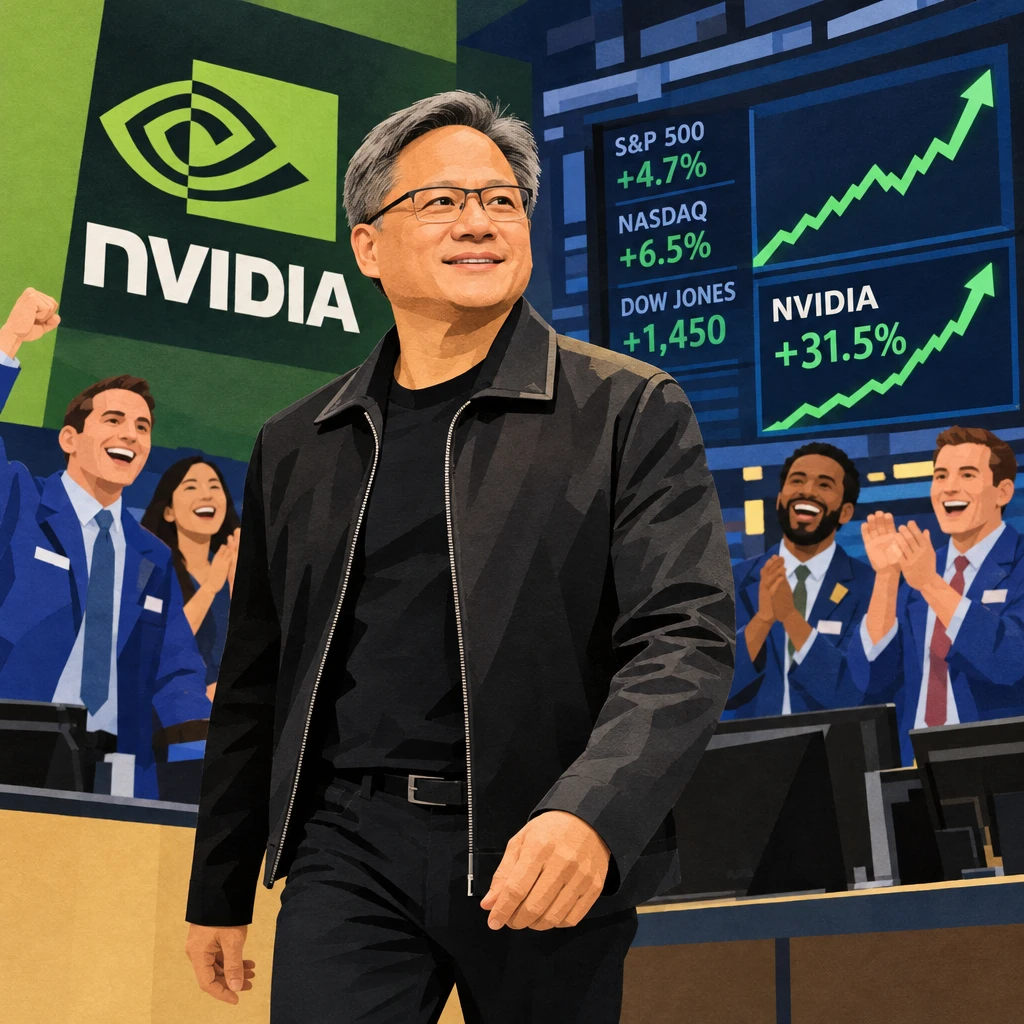
Here is what the coverage describes. The S&P 500 rose about 4.7%. The Nasdaq climbed roughly 6.5%. The Dow Jones Industrial Average gained nearly 1,450 points. Together, those moves recovered a meaningful portion of the losses from the previous week’s market decline. For anyone who had spent the prior days staring at red numbers, that kind of rebound is the financial equivalent of finding out the storm was not as bad as the forecast said.
The headline act was Nvidia itself. Its stock reportedly closed up 31.5% on the day, adding around $950 billion in market value. That figure is described as the largest single-day gain for any company on record. Let that sink in for a second. Most of us think a good day at work means finishing a project early or getting a compliment from the boss. Nvidia apparently managed to add close to a trillion dollars in value in a single session. Even by the standards of modern tech stocks, that is a lot of zeros.
Why would one leadership announcement move the entire market like this? Part of the answer is that Nvidia is no longer just a company that makes graphics chips for gamers. Its processors have become central to artificial intelligence work, and many investors treat the company as a bellwether for the whole AI boom. When a company that large and that influential changes course at the top, people pay attention. Investors tend to see stable leadership as a signal of confidence, and a sudden reversal of a leadership situation can quickly change how the market reads the company’s future.
It is also worth noting that the reports come from several outlets, including News Next News Network, TheJournal.ie, and Anadolu Ajansı. Each framed the story slightly differently. One called it a market meltdown reversed and the best day on Wall Street in over a year. Another focused on tech stocks rebounding as Wall Street rallied. The consistent thread is the same: a sharp rally tied directly to Huang’s return.
That said, a dramatic story like this deserves a healthy dose of skepticism. Before you rearrange your investments around a single headline, check the numbers against official exchange data and company statements. Market reports can contain errors, and fast-moving stories sometimes get corrected or clarified later. Investing based on one dramatic day is a bit like judging a whole season of a show based on its season finale.
Still, the broader lesson is hard to ignore. Markets are powered by expectations, and leadership is one of the biggest drivers of those expectations. When trust in a company’s direction returns, prices can respond with startling speed. And when a stock market swings by thousands of points in a day, it reminds everyone that Wall Street never gets boring for very long.
So what should you take away? Stay curious, stay skeptical, and maybe keep a little popcorn nearby the next time a market story sounds too dramatic to be true. Sometimes it is, and sometimes it is exactly as wild as it sounds.
Inspired by: “US stocks surge after surprise return of Jensen Huang as Nvidia’s chief executive” (r/News)