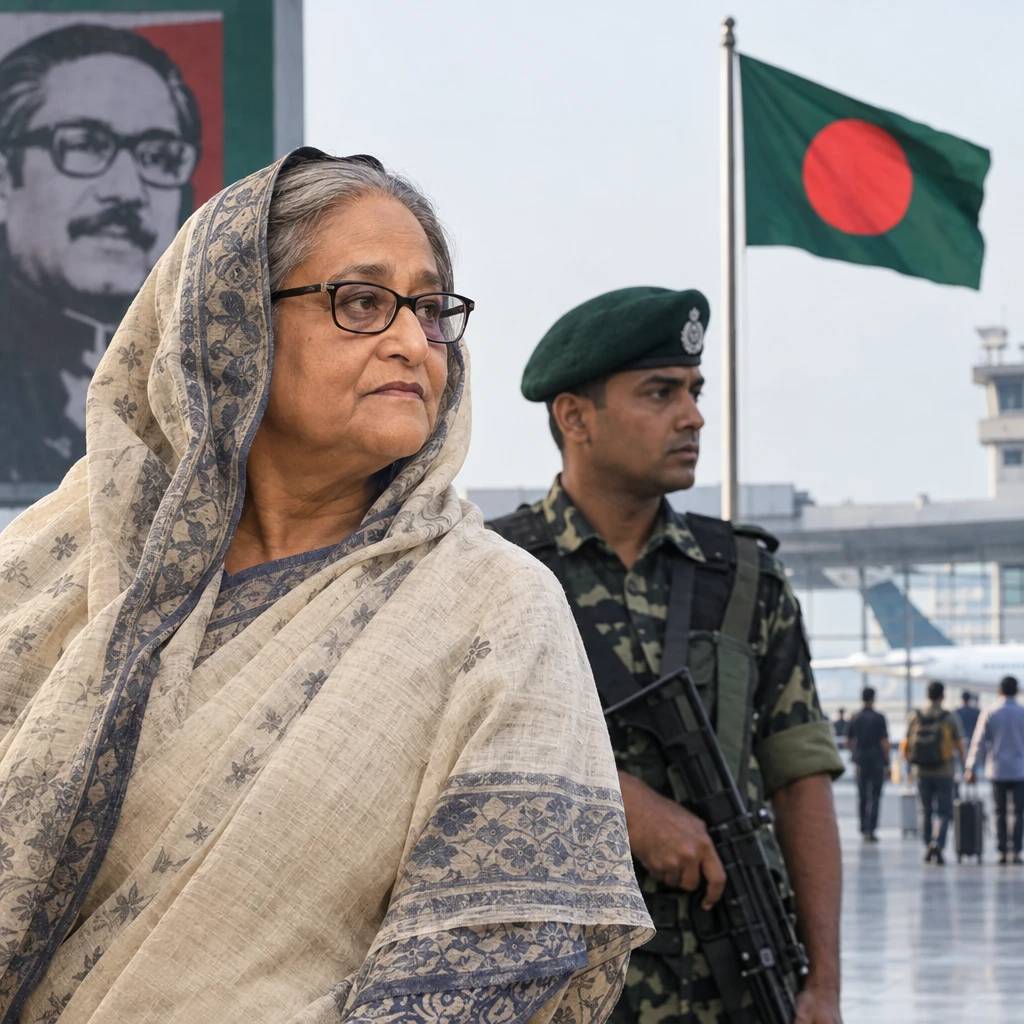
The Bangladesh government has said that ousted Prime Minister Sheikh Hasina's wish for homecoming on December 16 does not match the reality, and she can only return "in handcuffs" as a "terrorist".
Every so often, a political story arrives with a headline so blunt that you have to read it twice. This week’s example comes out of Bangladesh, where the government has made it clear that former Prime Minister Sheikh Hasina can come back only in one of two ways: extradited from India, or brought home under very tight control. Freely strolling through the arrivals gate is not on the table.
For context, Hasina led Bangladesh for many years before being forced out of power amid mass protests in 2024. She left for India, and she has since been sentenced to death in absentia for her role in a crackdown on student protesters. In absentia means the verdict was handed down without her in the courtroom, which tends to make homecoming plans a bit awkward.
And yet, according to reports, Hasina has asked to return to Bangladesh on December 16. Her request has landed in Dhaka like a hot potato nobody wants to hold for long.
The government’s response has been pointed. A state minister said that if she comes back, she would need to be brought under strict surveillance or in handcuffs. Several outlets picked up on the wording, and the headlines did not soften it. One Times of India piece put it as ‘Terrorist can return only in handcuffs’, while Hindustan Times framed it as ‘She can return only in handcuffs, says Dhaka as Sheikh Hasina eyes Dec 16 homecoming’. NDTV’s version, ‘Terrorist Can Only Be Extradited’, summed up the official position in a single line.
It is worth pausing on the wording, because the government is making two separate points. The first is legal: Hasina is a convicted figure in Bangladesh, so from Dhaka’s perspective her status is not that of an ordinary returning citizen. The second is political: the government wants to signal that it will not treat her return as a victory lap. Whether you see that as principled or as the predictable posturing of a government settling old scores, it is clearly a message meant for both domestic audiences and the wider region.
The bigger question is what happens next. Extradition depends on agreements and cooperation between two countries, and India has not been especially chatty on the subject in the reporting so far. That leaves a lot of room for speculation, and a lot of diplomatic tiptoeing. Any move to hand her over would be a major step in already strained relations, while continued silence keeps the matter hanging in the air.
There is also the human side of the story, which often gets lost in the legal and diplomatic back-and-forth. Hasina’s supporters and critics see her very differently, and the crackdown on student protests remains a deeply painful memory for many Bangladeshis. For some, a return under handcuffs would feel like long-overdue accountability. For others, it would look like a politically charged spectacle. Both reactions show how much this story is about the country’s recent past, not just its immediate future.
So where does that leave us? A former leader sentenced to death wants to come home on a specific date, and her government-in-waiting says she can only do so as a prisoner-in-custody, or not at all, depending on how talks with India go. It is the kind of situation that makes a simple ‘homecoming’ sound anything but simple.
If December 16 arrives and the story has moved on, that will tell us something too. For now, the message from Dhaka is loud and clear, and the rest of the region is waiting to see whether anyone is willing to blink first.
Inspired by: “’Terrorist Can Only Be Extradited’: Bangladesh On Sheikh Hasina’s Return Plan” (r/World)