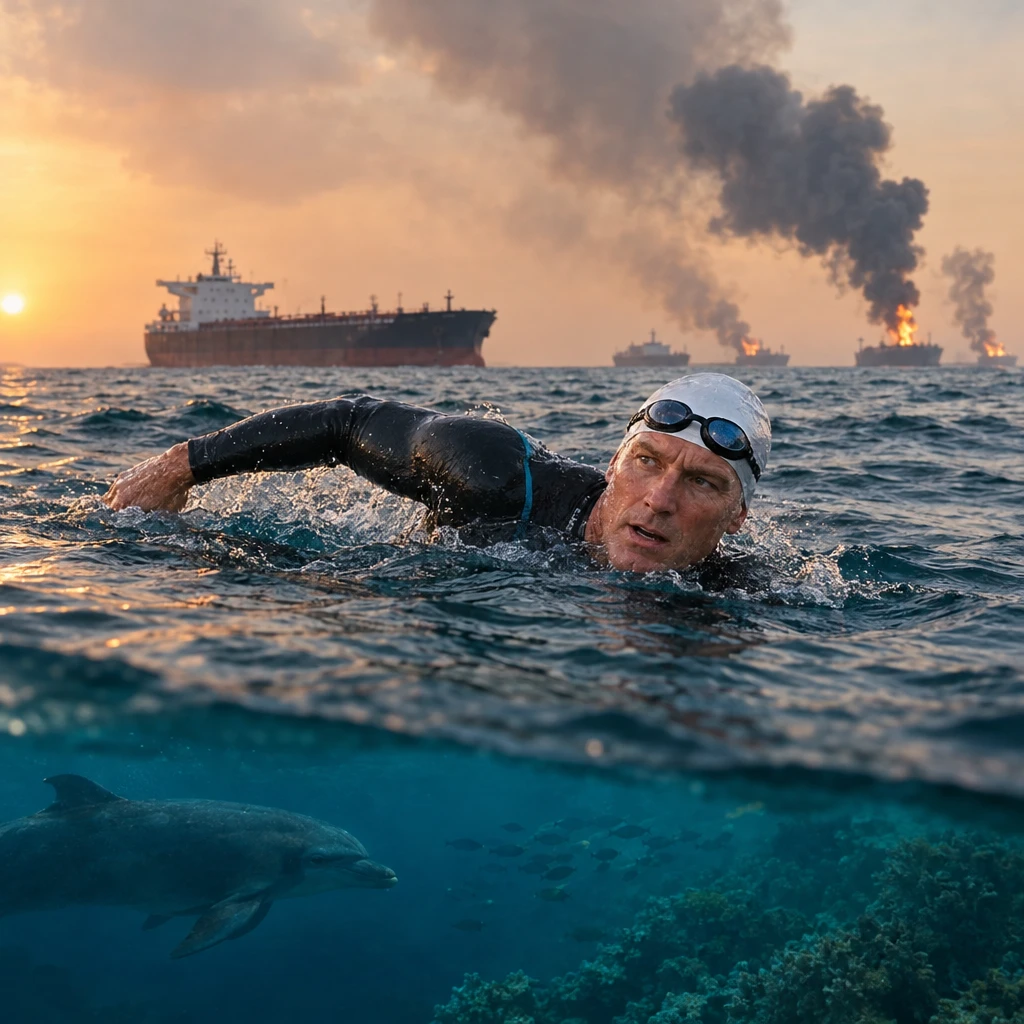
But battling freezing waters and extreme conditions hasn’t prepared him for his latest challenge: swimming the Strait of Hormuz while tankers are attacked and blown up nearby . Pugh, who is a United Nations Patron of the Oceans, spent three …
Most of us have trouble getting into a cold pool without yelping. Lewis Pugh, the British endurance swimmer and UN Patron of the Oceans, decided to skip the yelping and go straight to swimming through a conflict zone. Over three days, he swam roughly 15 kilometers through the Strait of Hormuz, and he did it with a very specific goal: to draw attention to what war does to the wildlife and habitats in and around the water.
If you’re not familiar with the Strait of Hormuz, here’s the short version. It’s a narrow waterway linking the Persian Gulf with the Gulf of Oman and the wider Arabian Sea. A large share of the world’s oil travels through it, which is why it tends to show up in the news whenever tensions in the region flare. It’s also a busy, sensitive marine environment, home to fish, marine life, and coastal ecosystems that don’t really care about geopolitics. They just get caught in the middle.
That’s where Pugh’s swim comes in. The reports describe him navigating waters near recent tanker attacks, with explosions heard around him during the journey. Reading that, my first thought was that this is not how most people choose to spend a long weekend. My second thought was that someone had to make this point in a way that people would actually notice, and a man swimming through a war zone is certainly hard to scroll past.
Pugh’s approach is nothing new for him. He has built a career on using extreme open-water swims to talk about environmental issues. He has previously undertaken similar swims at places such as the North Pole and Antarctica, where the message is usually about melting ice, changing oceans, and the fragile ecosystems that depend on them. Coverage of this latest swim also points to other remote and dramatic challenges in his record, including the Red Sea and Everest, which tells you he doesn’t have much interest in comfortable choices.
Why does this matter beyond the spectacle? Because conflict’s environmental costs are easy to overlook. When people talk about war, they usually focus on casualties, infrastructure, and politics. Far less attention goes to oil spills, damaged shipping, disrupted fishing grounds, and the long-term harm to marine habitats. Those effects can linger for years after the headlines move on. Fish stocks don’t recover just because a ceasefire is announced, and coral and seagrass don’t bounce back on a news cycle.
There’s also a bit of irony here that’s hard to ignore. Shipping through the strait keeps the global economy running, yet the same waters that carry all that cargo are being pushed to their limits by military activity and attacks. Everyone agrees the ocean is important, right up until it becomes inconvenient. Pugh’s swim is a reminder that the sea doesn’t pick sides, and neither does the damage.
So, should you go out and try a three-day swim through a war zone? Probably not. Pugh’s preparation, experience, and risk tolerance are far beyond what most of us can manage, and his own safety should be taken seriously. The lesson worth taking away is simpler. Pay attention to the environmental side of conflict, support organizations that monitor and protect marine ecosystems, and be skeptical when someone tells you the ocean is somebody else’s problem.
Pugh has a knack for making people stop and look at things they would rather ignore. In this case, what he wants people to see is that the wildlife of the Strait of Hormuz is paying a price for a conflict it had no part in. That’s a message worth hearing, even if it comes wrapped in a swimmer doing something most of us would never dream of doing.
Inspired by: “Endurance athlete Lewis Pugh braves Strait of Hormuz amid explosions to highlight Iran war’s impact…” (r/News)