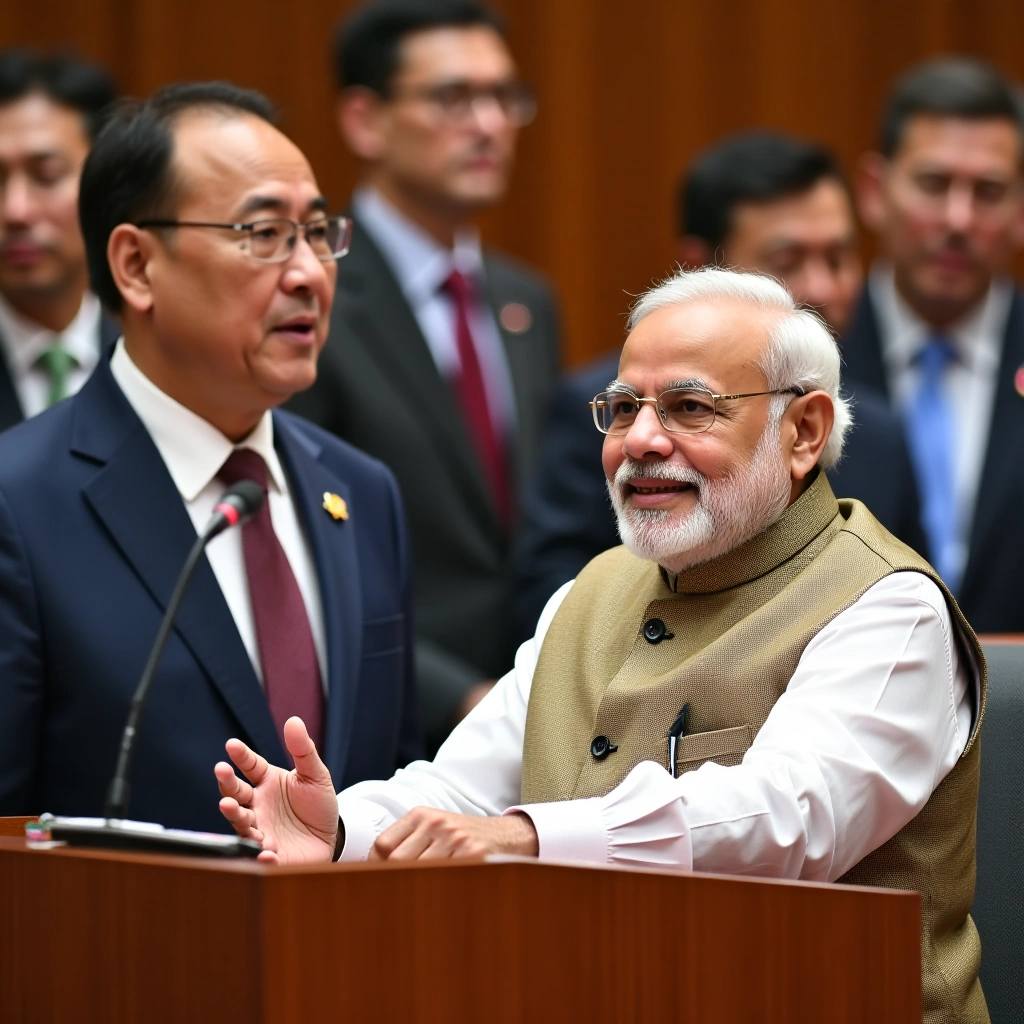
Modi, speaking at the India-ASEAN summit, said New Delhi's commitment to the grouping's unity and centrality in the partnership "is and will remain steadfast."
Every so often, world leaders gather in a room, sit behind tiny national flags, and say things that sound like they came from a corporate team-building retreat. This time, though, the message is worth a closer look. At the India-ASEAN summit, Prime Minister Narendra Modi told the assembled leaders that the future of both regions must be shaped by “cooperation, not competition.”
Yes, it sounds like something stitched onto a cushion. But behind the slogan is a serious argument about scale, stability, and how countries should behave when the world keeps throwing crises at them like an overenthusiastic pitching machine.
The Headline Message
According to coverage from outlets including Deccan Herald, NDTV, and The Hindu, the core of Modi’s address was simple: India and ASEAN should build their shared future by working together rather than trying to outmaneuver each other. One version of the quote, reported by The Hindu, framed it as “Our future is shaped not by competition but by cooperation.” Same idea, slightly different word order. Diplomats love a good rephrase.
This isn’t a new love language for India and ASEAN, either. Modi used the occasion to reaffirm New Delhi’s commitment to the partnership, which is diplomat-speak for “we’re still in this, and we’d like everyone to know it.”
A Quarter of the World in One Partnership
One of the more striking points Modi raised was the sheer size of the relationship. Together, he noted, India and ASEAN represent nearly a quarter of the world’s population.
Let that sink in. Roughly one in four people on the planet lives in a country covered by this partnership. That’s not a niche club. That’s a demographic heavyweight.
Why does this matter? Because when that many people are involved, the decisions made between these governments ripple outward into trade, travel, jobs, supply chains, and everyday life. Cooperation at that scale can create enormous benefits. Competition at that scale, on the other hand, can get expensive, messy, and unproductive in a hurry. It’s the difference between a group project where everyone pulls their weight and one where everybody fights over who gets to present the final slide.
Why “Cooperation, Not Competition” Is More Than a Nice Phrase
It’s easy to be a little cynical about summit slogans. Leaders say a lot of pleasant things at these events, and the cameras love a handshake. But the framing here reflects a real choice countries face.
Neighboring regions can approach each other as rivals, constantly trying to win at the other’s expense. Or they can treat each other as partners whose success is linked. Modi’s message clearly leans toward the second option.
The logic is pretty straightforward: when two large, connected regions cooperate, they can pool strengths, smooth out frictions, and respond to shared problems more effectively. When they compete aggressively, they risk duplicating effort, creating tensions, and generally making life harder for everyone involved. Nobody has ever looked back on a needless rivalry and said, “Wow, that was a great use of time.”
Peace, Stability, and Predictability
The other major theme of the address was the need for peace, stability, and predictability, especially in light of recent global crises.
If you’ve been paying even passing attention to the news lately, you’ll understand why these three words get top billing. The world has not exactly been in a calm, steady, predictable mood. Crises have a way of stacking up, and when they do, uncertainty spreads fast.
Predictability, in particular, is an underrated virtue in international relations. It doesn’t make for thrilling headlines, but it’s what businesses, governments, and ordinary citizens actually need. When partners can rely on each other to behave consistently, they can plan ahead, invest with confidence, and avoid nasty surprises. It’s the geopolitical equivalent of a friend who actually shows up when they say they will. Rare, valuable, and deeply appreciated.
By stressing these themes, Modi positioned the India-ASEAN relationship as something of an anchor: a partnership that can offer steadiness when much of the world feels anything but steady.
Reaffirming the Commitment
A big part of any summit speech is reassurance, and that was clearly on the agenda here. By reaffirming India’s commitment to the ASEAN partnership, Modi was signaling continuity. In other words, this relationship isn’t a passing phase or a seasonal fling. India intends to keep showing up.
That kind of message matters to partners. Relationships between countries, much like relationships between people, depend on trust. Repeating a commitment publicly, in front of the very leaders it concerns, is one way of reinforcing that trust.
What to Watch Going Forward
Of course, speeches are the easy part. The real test of “cooperation, not competition” will be what happens after the microphones are switched off and everyone flies home.
Will the partnership translate these principles into concrete action? Will the emphasis on peace and predictability hold up as new challenges emerge? Those are the questions worth keeping an eye on. A strong message sets the tone, but follow-through is what turns a slogan into a strategy.
The Bottom Line
Strip away the summit formalities, and Modi’s message to ASEAN leaders comes down to this: two regions that together account for nearly a quarter of humanity have more to gain from working together than from working against each other, especially in a world that keeps finding new ways to be unpredictable.
It’s not the flashiest idea ever floated at an international gathering. But sometimes the sensible ideas are the ones that matter most. Cooperation over competition, stability over chaos, predictability over surprise. If that sounds a bit like advice your sensible aunt would give, well, maybe your aunt was onto something all along.
Inspired by: “Our future must be shaped by ‘cooperation, not competition’: PM Modi to ASEAN leaders” (r/World)