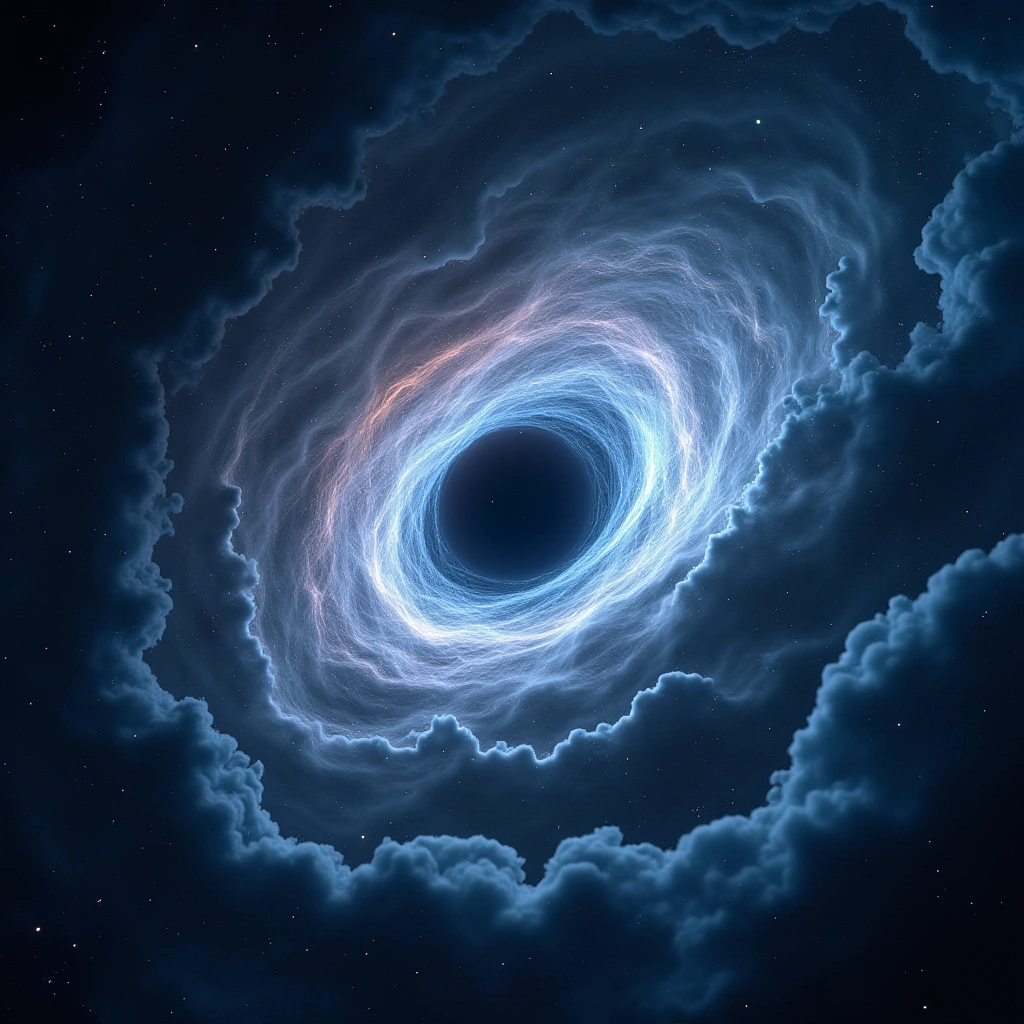
So, physicists have done it again. They’ve taken the mysteries of the universe, thrown them into a lab, and what do you know? They managed to simulate a black hole. Yes, you heard that right—those enigmatic cosmic vacuum cleaners that gobble up everything in sight have been recreated in a controlled environment. As if the world wasn’t already chaotic enough!
Steinhauer, for example, learned from his quantum replica that it emitted sonic waves analogous to the light waves that real black holes are supposed to produce, known as Hawking radiation. Because real black holes are so difficult to study, and Hawking radiation is so dim, researchers had never observed the radiation in outer space.
But hold on to your lab coats, folks, because the plot thickens. This black hole didn’t just sit there like a good little experiment. No, it started to ‘evaporate.’ That’s right—just like your hopes of getting through a Monday without coffee, this simulated black hole didn’t last long.
Now, let’s break this down, shall we? The concept of black holes is already mind-boggling. They’re regions in space where gravity is so strong that nothing, not even light, can escape. They’re like that one friend who keeps asking for rides but never pays you back. You can’t see them, but you know they’re there, draining the life out of you.
In the lab, researchers used a method called ‘analog gravity’ to simulate the conditions around a black hole. They created a setup that mimicked the event horizon—the point of no return. It’s like putting up a sign that says, ‘Enter at your own risk,’ but for particles instead of people.
And then came the magic moment: the black hole started to evaporate. This phenomenon is based on a theory proposed by the legendary Stephen Hawking, who suggested that black holes can emit radiation and lose mass over time. It’s a bit like that time you thought you’d save money by skipping lunch, only to find yourself buying snacks from the vending machine every hour—eventually, you’re just losing more than you bargained for.
The researchers observed that their black hole, which was not nearly as dramatic as the ones in sci-fi movies, began to lose its mass and energy. It’s like watching your favorite ice cream cone melt on a hot summer day—sad, yet strangely mesmerizing.
You might be wondering, why is this important? Well, simulating black holes could lead to a better understanding of fundamental physics, including theories of quantum gravity and the nature of our universe. Plus, it gives scientists a chance to play with some truly wild concepts without needing a spaceship or a time machine. Let’s face it, being a physicist is kind of like being a kid in a candy store, except the candy is made of complicated equations and the store is located in a dimension we can barely comprehend.
In conclusion, while we may not have the ability to hop into a spaceship and visit a black hole just yet, creating one in a lab is a pretty impressive step forward. Just remember, if you ever hear scientists talking about ‘evaporation,’ it’s probably not about them forgetting to water their houseplants. It’s just another day in the wild world of physics, where even black holes can’t resist the urge to take a little vacation.
So, next time you hear about a black hole, just remember that it might not be as scary as it sounds. They’re just misunderstood cosmic entities trying to find their place in the universe—kind of like us, really.
Inspired by: “Physicists Simulated a Black Hole in a Lab. Then It Started to ‘Evaporate’.” (r/technology)