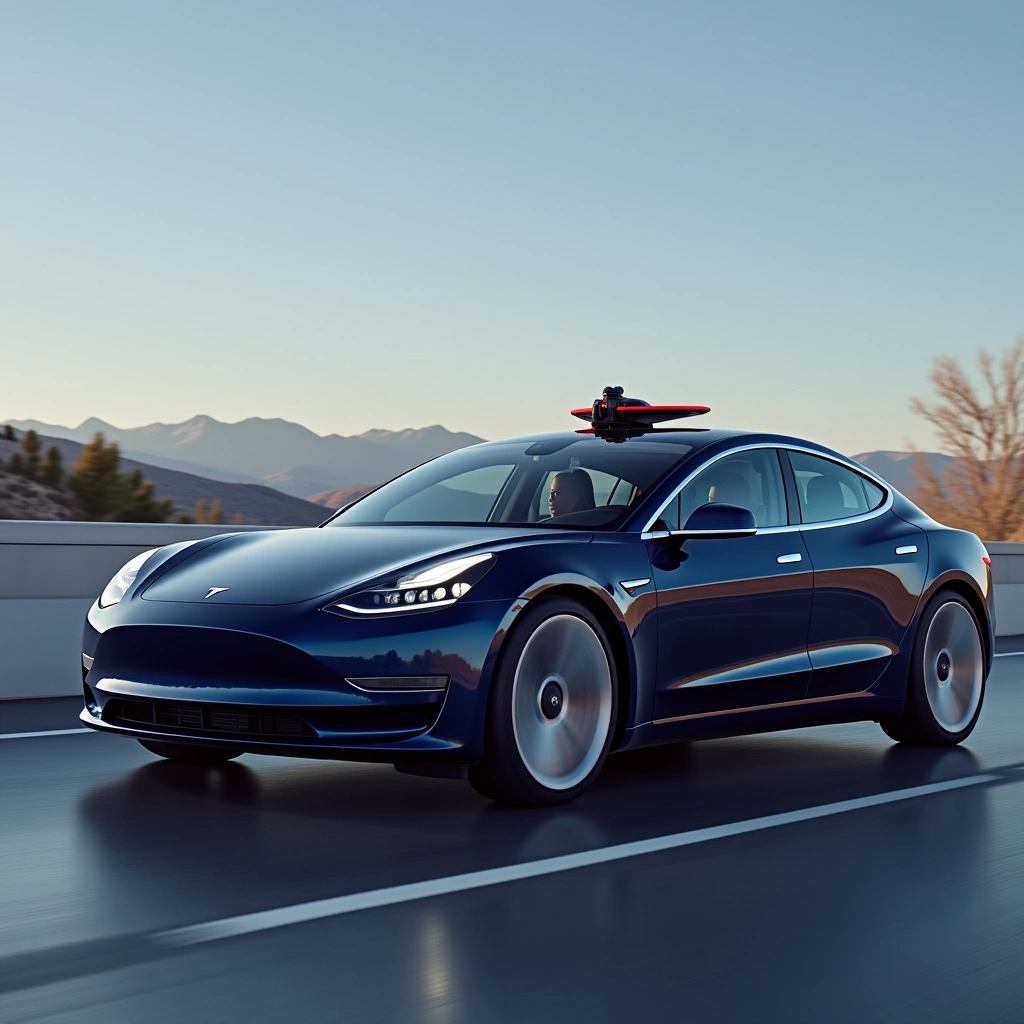
Ah, self-driving cars. The stuff of futuristic dreams and the occasional meme about how one day we’ll all be sipping coffee while our cars drive us to work. But, as with all dreams, there’s a catch—especially when it comes to the ongoing battle between Tesla and Waymo. Recently, Waymo’s CEO decided to throw a little shade on Tesla’s camera-only approach to self-driving technology, and let me tell you, it’s been quite the spectacle.
Waymo co-CEO Dmitri Dolgov laid out the clearest technical case yet for why cameras alone can’t take a self-driving system to full autonomy, arguing that “weak sensing” hits a safety ceiling long before it reaches superhuman performance.
Now, before we dive into the nitty-gritty of the debate, let’s take a moment to appreciate the fact that we’re talking about self-driving cars as if they’re competing in some kind of high-stakes reality show. Picture it: Tesla, the flashy contestant with the cool sunglasses and the all-electric charm, strutting its stuff with a camera-only system. Then there’s Waymo, the more methodical, slightly nerdy competitor, armed with a full arsenal of sensors, LIDAR, and what I can only imagine is a very impressive spreadsheet.
So, what’s the beef? According to Waymo’s CEO, the crux of the issue lies in safety and reliability. Tesla’s approach, which relies heavily on cameras and computer vision, is like trying to navigate a storm with just a pair of binoculars. Sure, you can see some things, but what about all the stuff happening around you that you might not notice? It’s like trying to find Waldo in a Where’s Waldo book, but you can only look at one page at a time. Not ideal, right?
Waymo, on the other hand, employs a multi-faceted approach that includes LIDAR (Light Detection and Ranging) technology. Think of LIDAR as the Swiss Army knife of self-driving technology—it can measure distances to objects, create 3D maps of the environment, and help the car understand its surroundings in a way that a camera alone simply can’t. It’s like having a personal assistant who not only tells you where to go but also warns you about that pothole you definitely would have missed.
But here’s where it gets a bit spicy: Tesla supporters often argue that their system is more adaptable and relies on neural networks to learn from real-world data. They believe that the cameras can eventually outperform LIDAR. It’s like a classic showdown between the old-school and the new-school. But as Waymo’s CEO points out, adaptability is great, but it doesn’t replace the need for comprehensive data to make informed decisions. In other words, you can’t just wing it when you’re driving at 70 miles per hour.
Let’s not forget the elephant in the room: the accidents. Tesla’s had its fair share of mishaps while relying on its camera-only system. Meanwhile, Waymo has been quietly racking up miles with its fully autonomous vehicles, boasting a safety record that would make even the most cautious of drivers nod in approval. It’s like the tortoise and the hare, but in this version, the tortoise has a much better insurance plan.
In conclusion, while Tesla may be the flashy rock star of the self-driving world, Waymo is the steady, dependable band that’s been honing its craft in the background. The debate over camera-only versus multi-sensor systems isn’t just about technology; it’s about safety and, ultimately, the future of how we’ll all get from point A to point B without a hitch. So, next time you’re stuck in traffic, just remember: it’s not just about the destination, but how many sensors you have keeping you safe on the way there. And as always, stay tuned for the next episode of “As the Self-Driving World Turns.”
Inspired by: “Waymo CEO explains why Tesla’s camera-only self-driving falls short” (r/technology)