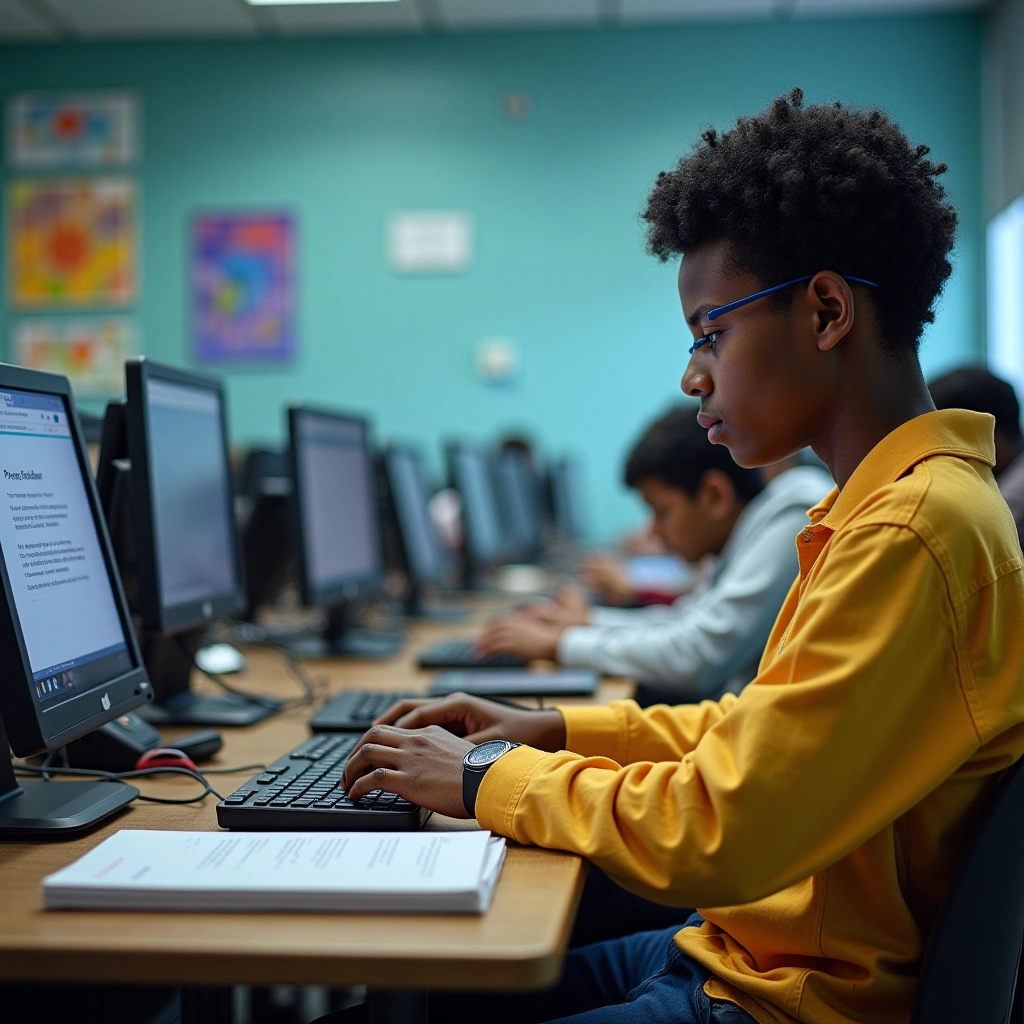
Let’s take a moment to talk about the educational crisis lurking in our classrooms like a forgotten lunch in a student’s backpack. You know the one—the kind that smells so bad it could be classified as a biohazard? Yeah, that’s kind of what’s happening with America’s math and reading scores right now. Spoiler alert: It’s not pretty.
According to Horvath, student AI use is not conducive to learning because it mirrors the failures of the 20th century “teaching machines.” Students’ learning was individualized—they answered questions from the device at their own pace …
You might have heard the news: after schools decided to swap out textbooks for screens, the results have been nothing short of catastrophic. I mean, who needs good ol’ reliable paper when you can have a shiny tablet that distracts kids with videos of cats doing backflips? Clearly, that’s where the real educational value lies.
According to recent studies, American students’ proficiency in math and reading has dropped faster than a lead balloon. And let’s be honest, it’s not just a small dip—it’s more like a free fall into the abyss. We traded in our trusty textbooks for screens that seem to have the attention span of a gnat. Who knew that replacing something as tactile as a book would result in brain rot?
Now, I’m not saying that technology doesn’t have its perks. I mean, who doesn’t love the convenience of Googling everything instead of flipping through pages? But when screens become the sole source of learning, it’s like trying to bake a cake with only half the ingredients. Sure, you might end up with something that resembles a cake, but it’s definitely not going to win any awards.
And here’s where it gets even juicier. Enter AI, the shiny new toy that everyone is raving about. Schools are starting to integrate AI into their teaching methods, which sounds great in theory until you realize that AI doesn’t exactly have the best track record when it comes to accuracy. It’s like trusting a toddler to babysit your pet goldfish—sure, it sounds like a fun idea, but it probably won’t end well.
Incorporating AI into education can be beneficial, but let’s face it: if we can’t even get kids to focus on a screen, how are we going to expect them to learn from a chatbot that can barely string a coherent sentence together? It’s like throwing spaghetti at the wall and hoping something sticks. Spoiler alert: it probably won’t.
So what’s the solution? Well, it might be time to consider a little balance. How about we bring back textbooks alongside the tech? Imagine a world where kids can actually read and comprehend without getting distracted by the latest TikTok dance challenge. Sounds revolutionary, right?
In conclusion, while screens and AI have their place in education, they shouldn’t be the only players on the field. Let’s not forget the good old-fashioned textbook—after all, it’s been around long enough to earn some respect. If we want to reverse this trend of declining math and reading scores, it might just be time to rethink our approach and maybe, just maybe, give those dusty old books a second chance. Because let’s face it, if we don’t, we might just end up with a generation that can’t even calculate how much pizza they need for a party. And that, my friends, is a tragedy we can’t afford to let happen.
Inspired by: “America’s math and reading scores tanked after schools ditched textbooks for screens—and AI could w…” (r/technology)