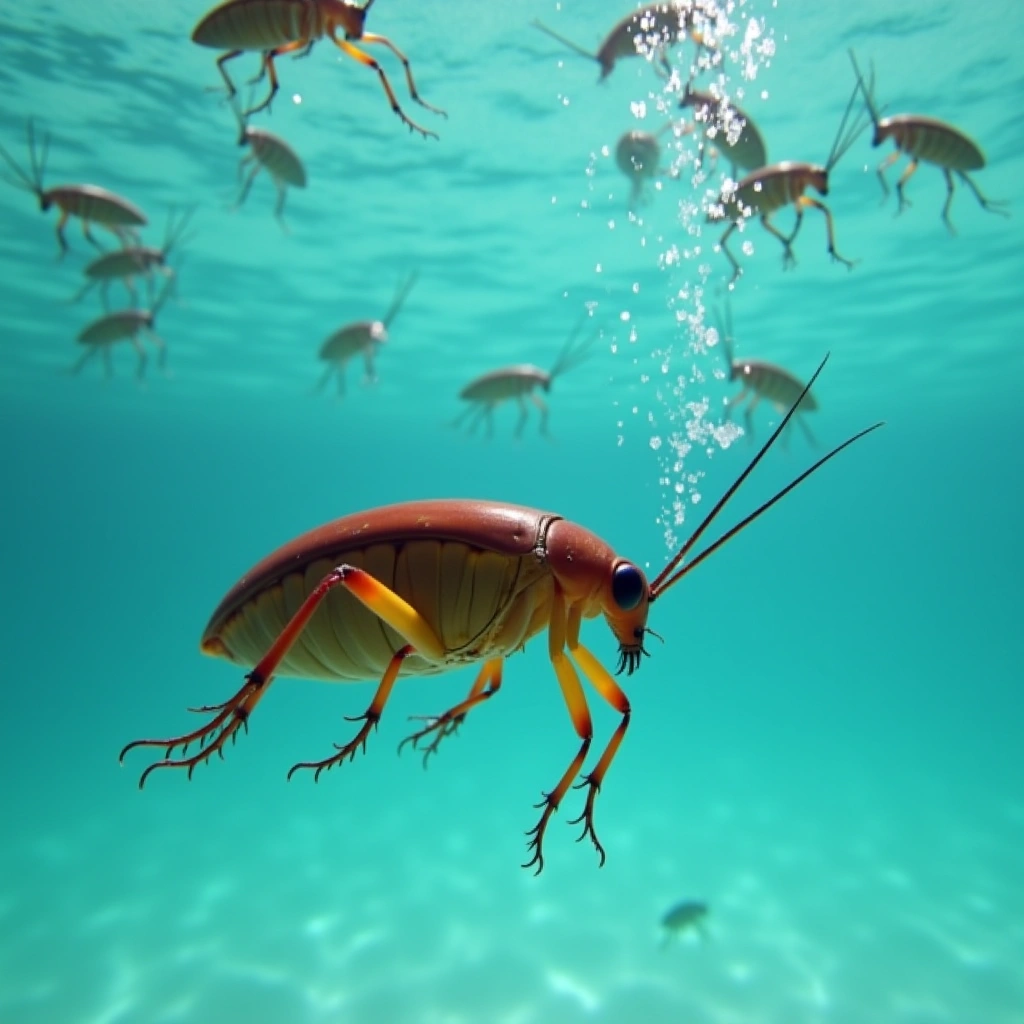
Have you ever thought to yourself, ‘You know what my life is missing? A swarm of remote-controlled cockroaches that can breathe underwater!’? No? Well, buckle up, because that’s exactly what we’re talking about today.
Researchers at Nanyang Technological University have developed 3D-printed diving suits that allow remotely controlled cyborg cockroaches to breathe underwater for up to three hours, enabling them to navigate flooded disaster zones. The suits utilize a chemical reaction between hydrogen peroxide and manganese dioxide to generate oxygen, bypassing the need for bulky pressurized tanks. This advancement builds on prior work where Madagascar hissing cockroaches were successfully remote-controlled via electrical implants, with potential future applications extending to space exploration on Mars.
In a remarkable leap for both science and our collective nightmares, researchers have developed a remote-controlled swarm of cockroaches that can not only scuttle around on land but can also dive into the depths of your worst fears (or, you know, just underwater). Yes, you heard that right! These little critters are now capable of breathing underwater.
Now, I know what you’re thinking: ‘Why on Earth would we want to control cockroaches?’ To which I say, why not? These little guys have been around for over 300 million years, and they’ve seen it all—from dinosaurs to the invention of the smartphone. If anyone’s qualified to survive in different environments, it’s them.
So, how does this all work? Researchers have cleverly attached tiny sensors to these roaches, allowing them to be controlled remotely. Thanks to some nifty bioengineering, these cockroaches can effectively swim through water, making them the ultimate survivalists. Imagine a scene from a sci-fi movie where a mass of cockroaches just glides through the water like it’s a day at the beach. Just don’t forget your sunscreen.
But before you start dreaming up plans for your very own cockroach army, let’s consider the implications. This technology could potentially be used for search and rescue missions, navigating through tight spaces in disaster zones, or even scouting out hazardous environments. I mean, who wouldn’t want a swarm of tiny robots—sorry, I mean cockroaches—looking for survivors in a collapsed building?
Of course, there are some ethical concerns regarding the use of live animals in this way. Are we crossing a line when we turn critters into little drones? And what about the cockroaches’ feelings? Do they even have feelings? It’s a slippery slope, folks. One minute you’re controlling cockroaches, and the next, you’re at the mercy of a cockroach uprising led by a particularly charismatic leader.
But let’s not get ahead of ourselves. For now, we can marvel at this fascinating intersection of biology and technology. Just imagine the possibilities! Maybe one day, you’ll be able to send a squad of cockroaches to fetch your remote control that you always lose. Or, they could help you find that one sock that always disappears in the wash.
In conclusion, while the thought of remote-controlled cockroaches that can breathe underwater may send shivers down your spine, it’s also a testament to human ingenuity. Just remember, with great power comes great responsibility. So, use your newfound cockroach army wisely, and for the love of all that’s good, don’t let them take over your living room.
Until next time, stay curious, and keep an eye out for any suspiciously organized cockroach gatherings!
Inspired by: “Remote-controlled cockroach swarm can now breathe underwater” (r/technology)