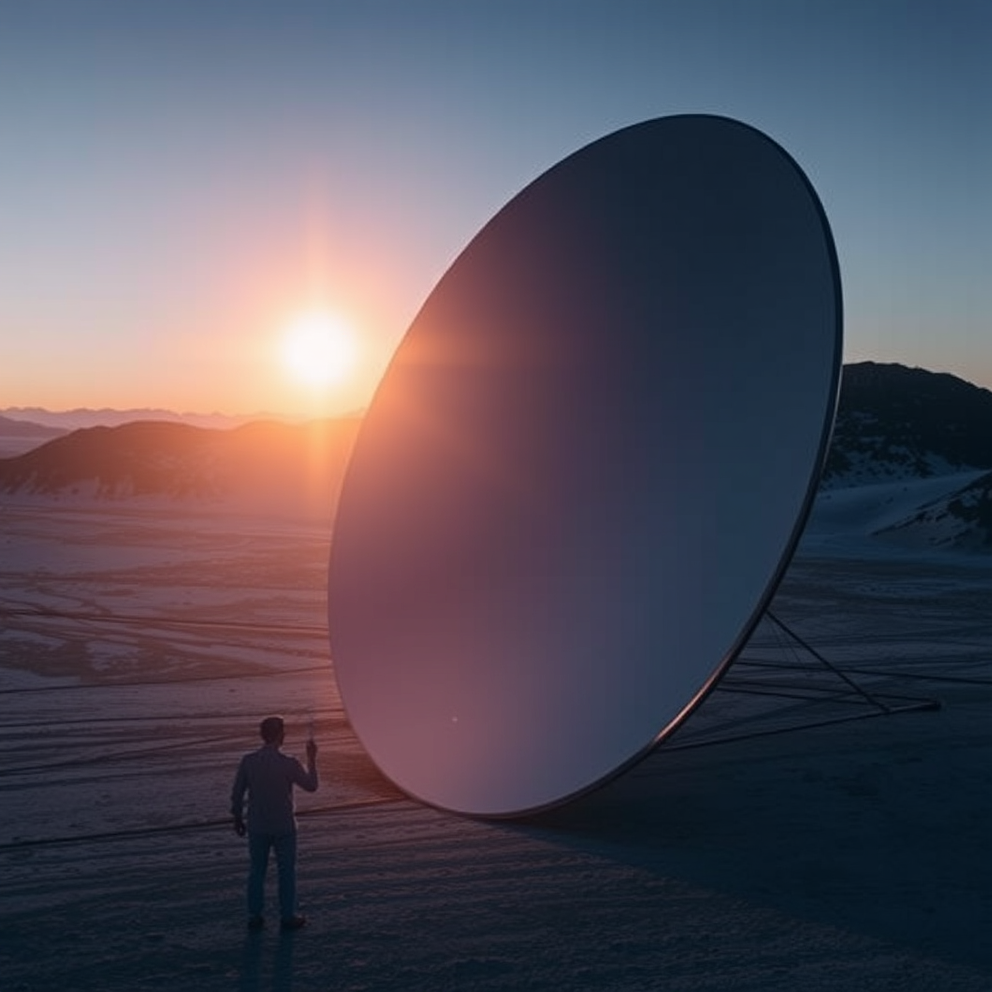
So, the FCC has approved a giant mirror satellite that aims to beam sunlight back to Earth after dark. Yes, you heard that right. We’re now taking our obsession with sunlight to astronomical levels—literally. If you’ve ever wondered what it would be like to live in a world where it’s permanently sunny, we might just be on our way there. But before you start envisioning sunbathing at midnight, let’s dive into what this giant mirror satellite really means for us.
In 1993, the Russian satellite Znamya, or “Banner,” deployed a 65-foot-wide sheet of mylar that reflected a beam of light twice as bright as the Moon, illuminating a roughly three mile wide circle onto the Earth below like an orbital spotlight.
First off, let’s talk about the concept. This satellite is designed to reflect sunlight down to Earth, illuminating areas that would otherwise be shrouded in darkness. Imagine a giant disco ball in the sky, but instead of playing cheesy 70s tunes, it’s just shining bright enough for you to find your keys at 2 AM. Sounds pretty useful, right? Or, depending on your perspective, it might feel like an invasion of privacy. After all, who wants a beam of light shining through their window at all hours?
Now, you might be thinking, “Why do we even need this?” Well, proponents argue that it could help in various ways, such as reducing energy consumption by decreasing our reliance on streetlights. This could be especially beneficial in remote areas where electricity is a luxury, or for those who just really, really want to avoid paying their electric bill. Plus, think of the potential for night-time outdoor activities. Suddenly, midnight picnics and late-night stargazing become a whole lot easier.
However, before we all get too excited about our new celestial nightlight, there are some concerns. Environmentalists are raising eyebrows, and not just because they’re worried about the potential for light pollution. There’s also the question of how this giant mirror will affect wildlife that relies on natural cycles of light and dark. Imagine a world where owls are confused about when to hoot, or where nocturnal critters start throwing off their sleep schedules. We could be looking at a lot of very cranky animals—because, let’s be honest, nobody wants to deal with a hangry raccoon at midnight.
Then there’s the technical side of things. Launching a giant mirror into space sounds like something straight out of a sci-fi movie, and let’s face it, the logistics are a bit daunting. Will it be able to withstand the harsh conditions of space? Will it be able to target specific areas without accidentally shining a spotlight on someone’s backyard barbecue? And who’s in charge of making sure it doesn’t accidentally blind a few astronauts along the way?
Despite these concerns, the potential benefits are hard to ignore. Imagine cities that are safer at night due to better lighting, or even the possibility of using this technology in disaster relief efforts. And hey, if it means we can throw more late-night barbecues without worrying about the neighbors complaining about the noise, I’m all for it.
In conclusion, while the giant mirror satellite might sound like a whimsical idea lifted from the pages of a comic book, it’s a very real project that could have significant implications for our future. Whether it ends up being a beacon of hope or just another light pollution nightmare remains to be seen. But one thing is for sure: we’re definitely living in the future, and it’s going to be bright—literally.
Inspired by: “FCC approves giant mirror satellite designed to beam sunlight to Earth after dark” (r/technology)