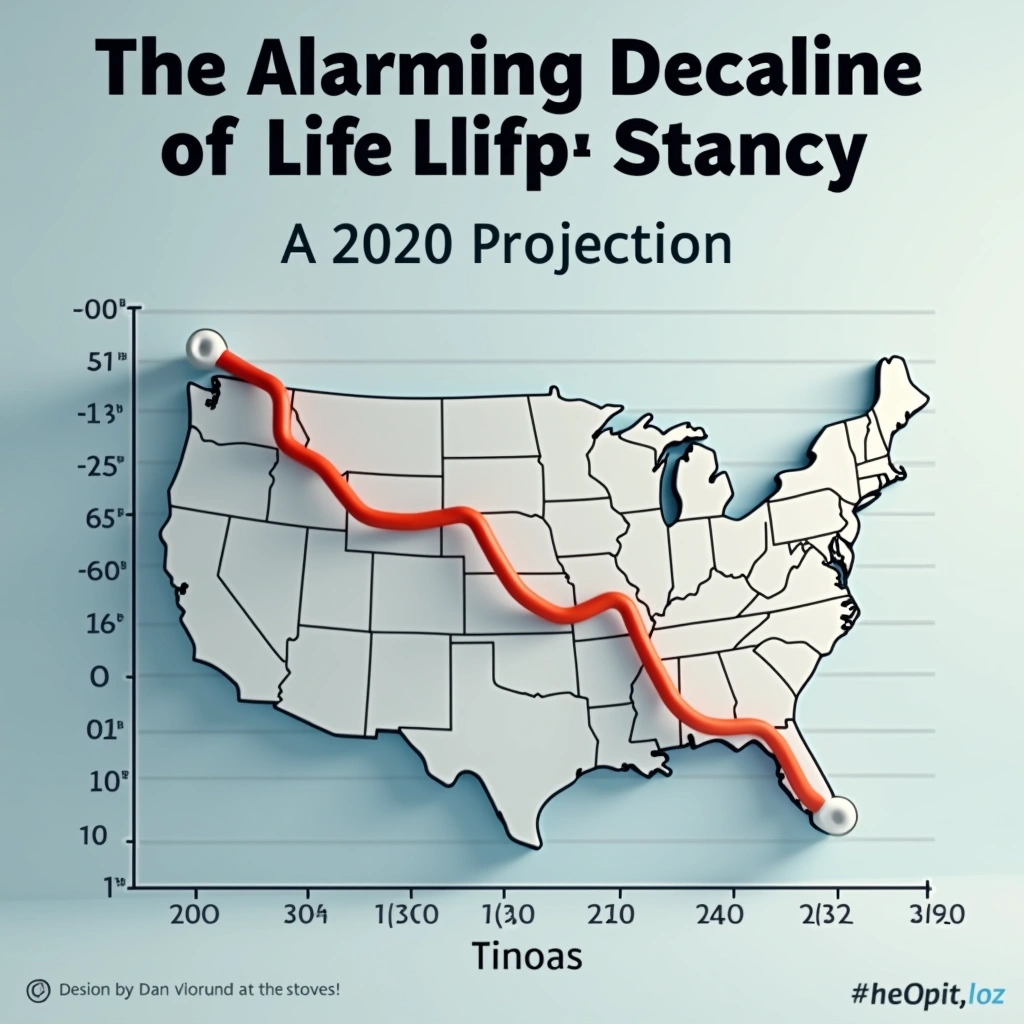
The United States, once a beacon of healthcare innovation and life expectancy, is projected to face a staggering decline in its average lifespan by 2030. According to a comprehensive study published in The Lancet by researchers from Imperial College London and the World Health Organization, the U.S. is set to fall near the bottom of the developed world in terms of life expectancy, trailing behind countries like Croatia and Mexico. This revelation is not just a statistic; it is a wake-up call for a nation that prides itself on its healthcare system.
A 2017 Lancet study projected that by 2030, U.S. life expectancy would fall to near the bottom of developed nations, potentially dropping below that of Croatia and Mexico due to chronic disease and unequal healthcare access. This prediction was complicated by a sharp, pandemic-driven decline between 2017 and 2021, which pushed life expectancy to a decades-low of roughly 76.4 years. Although recent recovery efforts have raised the average to 79.0 years by 2024, the U.S. still lags significantly behind peer nations, with structural issues like obesity and substance abuse keeping the projected 2030 decline trajectory largely in place.
In their groundbreaking research, the team utilized an ensemble of 21 probabilistic forecasting models to analyze life expectancy across 35 industrialized nations. While the findings highlighted the remarkable longevity of South Korean women—projected to exceed an average life expectancy of 90 years—the implications for the United States were far less optimistic. By 2030, the average American woman is expected to live only 83.3 years, while men will average 79.5 years. These figures starkly align the U.S. with countries that have historically struggled with healthcare access and chronic disease management.
The study’s findings are particularly alarming when considering the factors contributing to this decline. The United States is uniquely positioned as the only country in the OECD without universal health coverage. This lack of a comprehensive healthcare system has resulted in the largest share of unmet healthcare needs due to financial constraints. The consequences are dire: high rates of chronic diseases, persistent obesity, and significant health inequalities plague the nation, leading to stagnant or even declining life expectancy among certain demographics.
Moreover, the COVID-19 pandemic has exacerbated these issues, causing a sharp decline in life expectancy that outpaced the original projections made in 2017. The pandemic not only highlighted the fragility of the U.S. healthcare system but also exposed the deep-rooted disparities that exist within it. Vulnerable populations, particularly those in lower socioeconomic brackets, have borne the brunt of this crisis, further widening the gap in health outcomes.
As we look toward 2030, the implications of these findings are profound. The United States, a nation that has long considered itself a leader in healthcare, is facing a reality where its health outcomes are quietly collapsing relative to its peers. The trajectory suggests a future where American life expectancy may no longer be in the same league as other developed nations, raising critical questions about the efficacy of current healthcare policies and the urgent need for reform.
In conclusion, the projected decline in life expectancy for the United States serves as a stark reminder of the urgent need for systemic change. As we grapple with the implications of these findings, it is imperative that we address the underlying issues of healthcare access, chronic disease management, and health inequalities. The time for action is now; otherwise, we risk resigning ourselves to a future where American lives are measured not in years, but in lost potential.
Inspired by: “The Alarming Decline of Life Expectancy in the United States: A 2030 Projection”