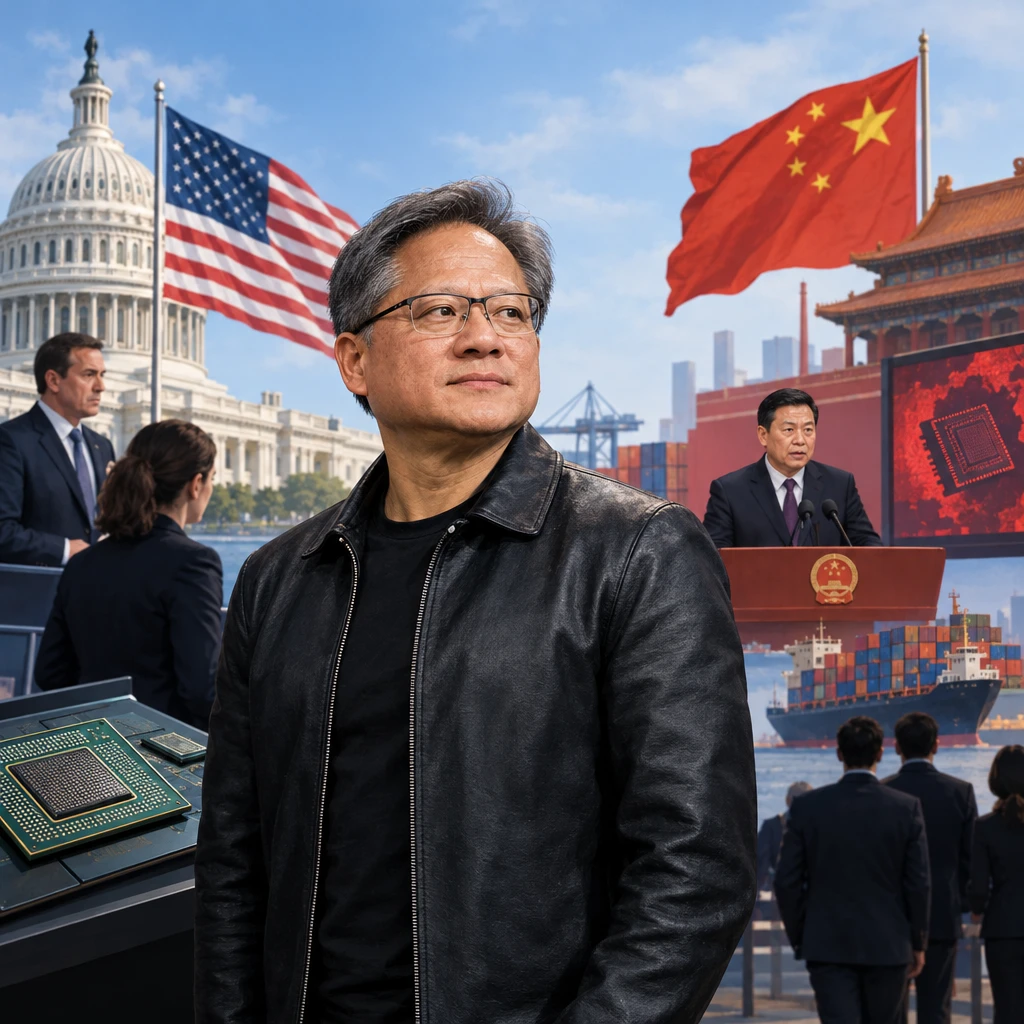
Chinese state media warned that Huang ’ s return would not automatically end what it called malicious efforts affecting China – U . S . relations. Beijing remains concerned about U. S . restrictions and the possibility of further export-control actions.
Every so often, a corporate shakeup lands in the news and makes you wonder whether anyone in the room was actually surprised. This week’s version: Jensen Huang has returned as chief executive of Nvidia Corp., bringing back a leader who had previously pushed back against restrictions on selling chips to China. Beijing’s reaction was about as subtle as a dropped tray in a quiet restaurant. The message was basically, ‘Nice try, but the rules aren’t changing.’
To understand why this matters, it helps to know what is at stake. Nvidia makes some of the most sought-after processors in the world, the kind used to train and run artificial intelligence systems. Those chips have become a major point of tension between Washington and Beijing, because the U.S. government has put export controls in place to limit which advanced technology can reach China. The argument from Washington has centered on national security and keeping the most powerful tools out of reach of a rival. Companies like Nvidia, meanwhile, have an obvious interest in selling to one of the largest tech markets on the planet.
So when a figure who had argued against those restrictions returns to the top job, it is natural for people to wonder whether the policy landscape might soften. Chinese officials, according to the reporting, do not expect that to happen. Their position is that existing U.S. export controls remain in place and that the concerns behind them have not gone away. Chinese state media went further, describing Washington’s actions as a continuing problem that could keep affecting relations between the two countries.
That phrasing is worth noticing. The word ‘malicious’ appeared in several headlines, which signals how strongly Beijing views the restrictions. From China’s perspective, the controls are not a neutral business matter but a deliberate effort to hold back its technological development. From Washington’s perspective, they are a safeguard. Those two readings are nearly impossible to reconcile, which is why this kind of story keeps resurfacing.
It also highlights an awkward reality for global companies. A chief executive can have strong views, make public arguments, and even influence debates, but a company operating across borders is still bound by government rules. Leadership changes can signal shifts in strategy, yet they rarely override the decisions made in capitals thousands of miles away. Anyone hoping that a single executive’s return would instantly reopen a major market is likely to be disappointed, at least in the short term.
For investors, customers, and policymakers, the takeaway is less about one name and more about the broader pattern. Export controls have become a long-running feature of the relationship between the United States and China, and both sides appear settled into their positions. Beijing is signaling patience and skepticism, while Washington has shown little sign of loosening its approach. In the middle sits a company whose products are central to the entire fight.
So, will Huang’s comeback change anything? Based on the response so far, the answer from Beijing is a fairly firm no. Whether that holds as technology and politics evolve is another question, but for now the message is clear: a new-look leadership team at Nvidia does not automatically mean a new look for US-China tech relations. Sometimes the most newsworthy thing is that the expected reaction arrived right on schedule.
Inspired by: “China Warns Huang Comeback Doesn’t End ‘Malicious’ Risks From US” (r/Business)