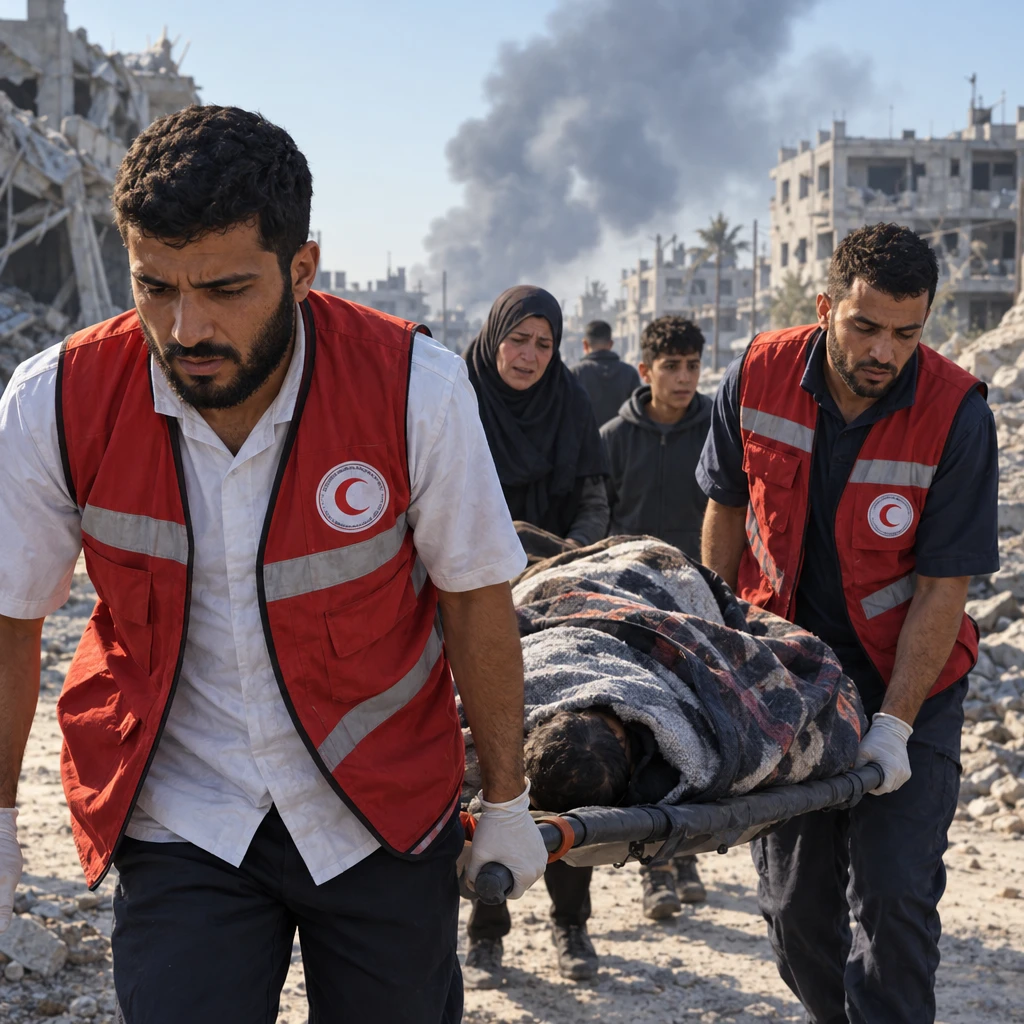
An Israeli quadcopter drone struck down three Palestinians in Khan Younis on Monday , the sources told Al Jazeera. … According to the sources, a Palestinian woman was also wounded by Israeli gunfire in the al-Batn al-Sameen area of Khan Younis.
If you’ve been following the news out of Gaza, you’ve probably noticed a pattern. A headline goes up, the details shift a little with every update, and somewhere in the middle is a ceasefire that everyone keeps mentioning and nobody seems to be sure how to describe. This week’s story is a good example.
On Tuesday, an Israeli airstrike, or possibly a drone strike, killed at least three Palestinians in Khan Younis, in southern Gaza. Five others were wounded. According to local sources, the target was a police outpost or an area near Street 5 in Al-Mawasi, and they reported that a drone carried out the attack. The fact that the reports differ on whether it was an airstrike or a drone strike is worth noting, because in a place where access is limited and information moves fast, first accounts often get revised.
What makes this incident stand out is the backdrop. It happened despite a US-backed ceasefire agreement reached in October 2025. You would think a ceasefire would mean a quiet period, or at least a noticeably quieter one. Instead, the agreement has not stopped ongoing Israeli military operations, and strikes like this one keep landing in the news. Calling it a ceasefire in the headline is technically accurate, but it can feel a bit like calling a leaky roof ‘mostly dry.’
The story also appeared across several outlets, which is a useful reminder of how the same event gets packaged differently. Salem Radio Network News and The Straits Times both framed it around medics saying at least three Palestinians were killed. Anadolu Agency described it as a drone strike on a Gaza police post. Economic news sites ran a shorter version of the same basic facts. Read together, the reports agree on the core: people were killed, others were hurt, and the attack was in Khan Younis. Where they differ is mostly in the terminology and the level of detail.
That’s the part that often gets lost. When you’re reading a breaking story about a strike in an active conflict zone, the early numbers are usually provisional. The death toll can rise. Descriptions of the target can change as more information comes in. Medics and local sources are often among the first to report, and they are working under very difficult conditions, so their accounts are important but also need to be weighed carefully as updates arrive.
So what should a reader take from this? First, that a single strike is rarely just a single strike. It is one data point in a longer story about whether a ceasefire means anything on the ground. Second, that the language of agreements and the reality of daily life can diverge sharply. A signed deal in October does not automatically translate into calm in Khan Younis in November, or whenever the next report lands. Third, that it is worth reading more than one source. Different outlets emphasize different things, and the overlap between them is often where the most reliable picture sits.
None of this makes the story easy to digest. Three people are dead, five more are injured, and the phrase ‘ongoing military operations’ is doing a lot of heavy lifting. It is a sobering reminder that behind every headline about a ceasefire or a strike are families, neighbors, and communities trying to figure out whether tomorrow will be any different from today.
Keep following the coverage, check multiple sources, and be a little skeptical of anyone who tells you the situation is simple. It isn’t.
Inspired by: “Israeli airstrike kills three Palestinians in southern Gaza” (r/News)