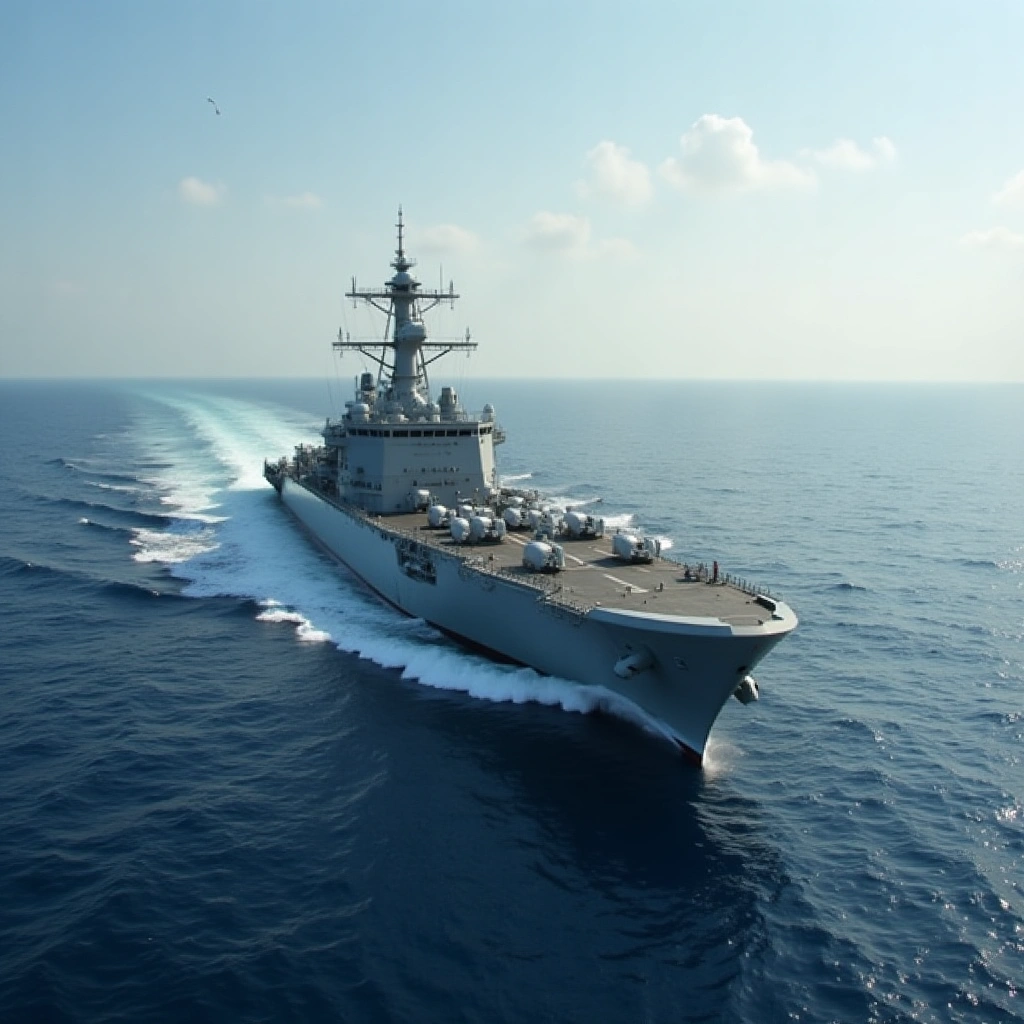
Saudi Arabia’s foreign minister said Riyadh appreciated “President Donald Trump’s decision to give diplomacy a chance to reach an acceptable agreement to end the war, restore the security and freedom of maritime in the Strait of Hormuz to its state prior to 28 February 2026 and address all points of contention in a way that serves the security and stability of the region”. He added: “Saudi Arabia looks forward to Iran seizing the opportunity to avoid the dangerous implications of escalation, and urgently responding to the efforts to advance the negotiations leading up to a comprehensive agreement”. View More
So, it seems the U.S. has decided to spice things up in the Strait of Hormuz with a few defensive strikes on Iranian targets. I mean, who needs diplomatic finesse when you can just lob some missiles instead, right? According to a U.S. official, these strikes were executed in response to some unspecified provocations. Because nothing says ‘let’s talk’ quite like a good old-fashioned airstrike.
Now, for those of you who might be wondering what the Strait of Hormuz is, let me break it down: it’s that narrow waterway where about a fifth of the world’s oil supply passes through. So, yeah, it’s kind of a big deal. Imagine it as the world’s busiest highway, but instead of cars, it’s tankers full of oil, and instead of traffic jams, you have geopolitical tensions. Quite the scenic route, if you ask me.
The strikes were described as defensive, which is a term that seems to be getting a lot of use lately. It’s like calling a donut “health food” because it has a hole in the middle. Sure, it sounds good, but we all know what’s really going on here. The U.S. is asserting its presence in a region that has seen its fair share of tensions. With every strike, it’s like they’re saying, “Hey, Iran, we’re watching you!”
Of course, this isn’t the first time we’ve seen military actions in this area. The Strait of Hormuz has been a hotbed of activity for years, with both countries flexing their military muscles like they’re in some sort of geopolitical bodybuilding competition. It’s all very dramatic and, frankly, exhausting to keep up with.
In the broader context, these strikes come just ahead of midterm elections in the U.S., making you wonder whether political motivations are at play. After all, nothing rallies the political base quite like a good foreign conflict. It’s like waving a red flag in front of a bull—everyone gets riled up, and suddenly, issues at home take a backseat.
So, what does this mean for the average Joe or Jane? Well, if you’re feeling the pinch at the gas pump, you might want to keep an eye on the news. Military actions often lead to fluctuations in oil prices, and nobody likes to pay more for their morning commute. Plus, let’s be honest, it’s just another reminder of how interconnected our world is and how events thousands of miles away can ripple through our daily lives.
In conclusion, while the U.S. might see these defensive strikes as a necessary show of strength, the rest of us are left to ponder the complexities of international relations. So, grab your popcorn, folks; it looks like the geopolitical drama is just getting started. And who knows? Maybe next time, they’ll decide to host a reality show instead of launching missiles—”Keeping Up with the Ayatollahs” has a nice ring to it, don’t you think?
Inspired by: “US has conducted defensive strikes on some Iranian targets in the Strait of Hormuz, US official says” (r/World)