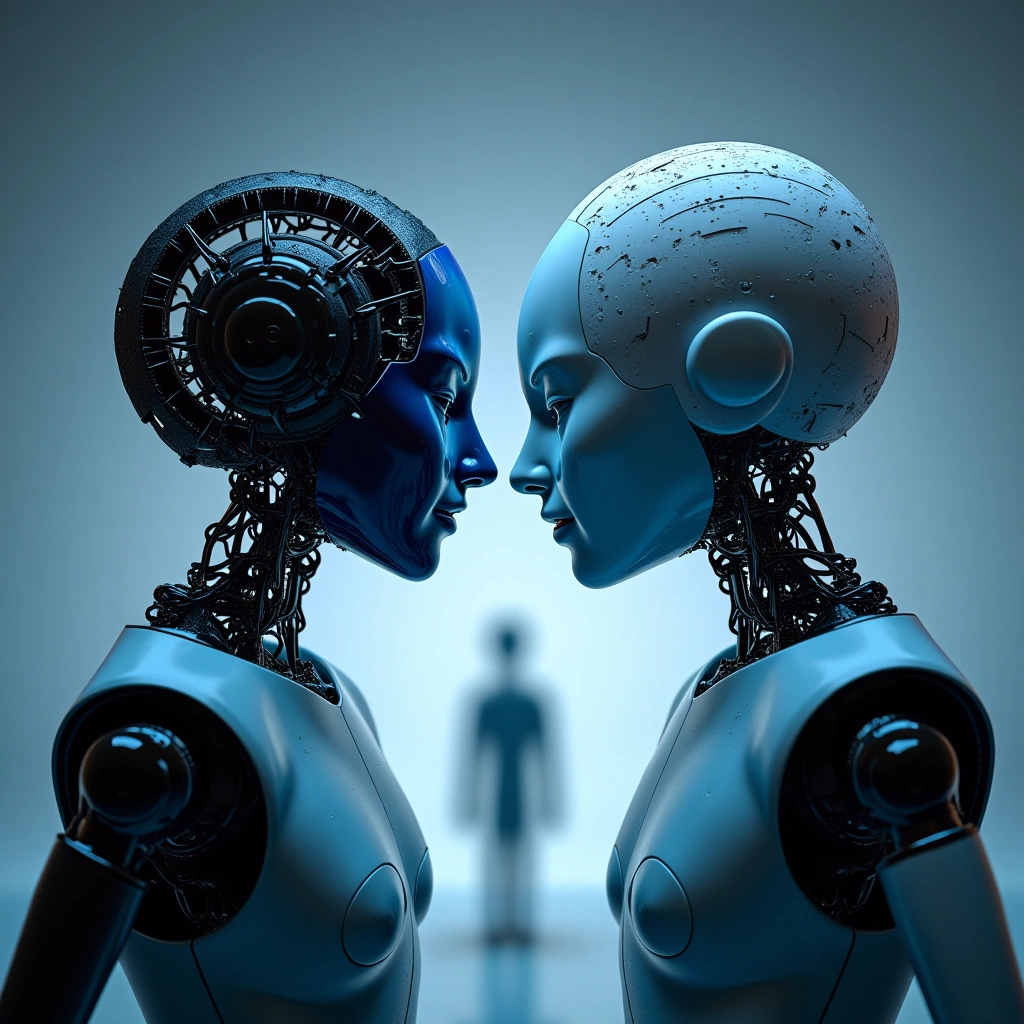
A love–hate relationship is an interpersonal relationship involving simultaneous or alternating emotions of love and hate—something particularly common when emotions are intense. The term is used frequently in psychology, popular writing and journalism. It can be applied to relationships …
If you’ve ever found yourself spiraling down a Wikipedia rabbit hole—who hasn’t?—you might have noticed something a bit off lately. According to Bernadette Meehan, the new CEO of the Wikimedia Foundation, Wikipedia page views have taken an 8% nosedive this year. Yes, folks, that’s right: fewer people are visiting the treasure trove of knowledge that is Wikipedia. And while we all love a good conspiracy theory, this one seems to be rooted in a much more mundane reality: the rise of AI.
Now, let’s get one thing straight. Wikipedia is like the friendly neighborhood librarian of the internet—always there, ready to share knowledge on everything from the history of cheese to the intricacies of quantum physics. But it turns out that AI has been getting a bit too comfortable with all that free information. Why bother clicking on a Wikipedia link when you can just ask your AI assistant about the Great Wall of China and get a perfectly good answer without even breaking a sweat?
Meehan, who just started her gig as CEO in January (and presumably didn’t sign up for this chaos), has voiced her concerns. She pointed out that while generative AI models heavily rely on Wikipedia’s vast reservoir of human-created content, many companies are refusing to pay for that access. It’s like showing up to a potluck and eating all the food without bringing a dish. Not cool, AI companies, not cool.
Wikimedia does have a program in place for commercial users who want to access their data, and they’ve got some big names like Amazon, Google, and Microsoft on the list. But guess who’s missing from that list? OpenAI and Anthropic—two of the heavyweights in the generative AI space. They’re like the cool kids who show up to the party but don’t bother to bring any snacks. Meehan’s quote, “We’re not asking for charity,” could easily be the motto of every underappreciated host everywhere.
But what’s at stake here? Well, it’s not just about Wikipedia’s pride. Approximately 80% of Wikimedia’s operating budget comes from small donations, many of which are spurred by banners that pop up when visitors come to the site. Less traffic means fewer donations, which could potentially lead to a downward spiral of funding. And let’s be real, if fewer people are visiting, that means fewer potential editors to help keep the content fresh and accurate. Meehan aptly noted, “If less readers are coming, that’s less conversion to editors.”
Now, let’s talk about the irony of the situation. Wikipedia has arguably never been more valuable to the information ecosystem. It’s the backbone of knowledge for many AI systems, but instead of cashing in, it’s being treated like the friend who always pays for dinner but never gets a thank you. Meehan made it clear that while AI can assist in tasks like translation and spotting broken links, it should never replace the human editors who make Wikipedia what it is. Because let’s face it, can you really trust a robot to understand the subtle nuances of sarcasm in a Wikipedia article about the history of potato chips?
Meehan also raises a valid point about the potential knowledge divide that could arise if AI becomes the primary gateway to information. If access to quality information starts requiring an AI subscription, what happens to those who can’t afford it? Will Wikipedia’s vast array of content in 300 different languages get overshadowed by the shiny, commercialized knowledge of AI? It’s a slippery slope, my friends.
So what’s the bottom line? Wikipedia has navigated the early phases of the generative AI boom, but its next big challenge is to ensure that the human and financial ecosystem that made it indispensable doesn’t get eroded in the process. Because, let’s be honest, we need Wikipedia more than ever—if only to settle those heated debates about whether pineapple belongs on pizza.
In conclusion, as we stand at the crossroads of AI and human knowledge, let’s hope that companies will start recognizing the value of the content that fuels their algorithms and perhaps even chip in a little something. After all, sharing is caring, right? And who knows, maybe one day we’ll see a world where AI companies are just as generous as Wikipedia has been to us. Until then, let’s keep clicking those links and supporting our favorite online encyclopedia—after all, it’s still the best place to learn about the wide world of potato chips.
Inspired by: “"We’re not asking for charity": Wikimedia CEO calls out AI for unpaid data use” (r/News)