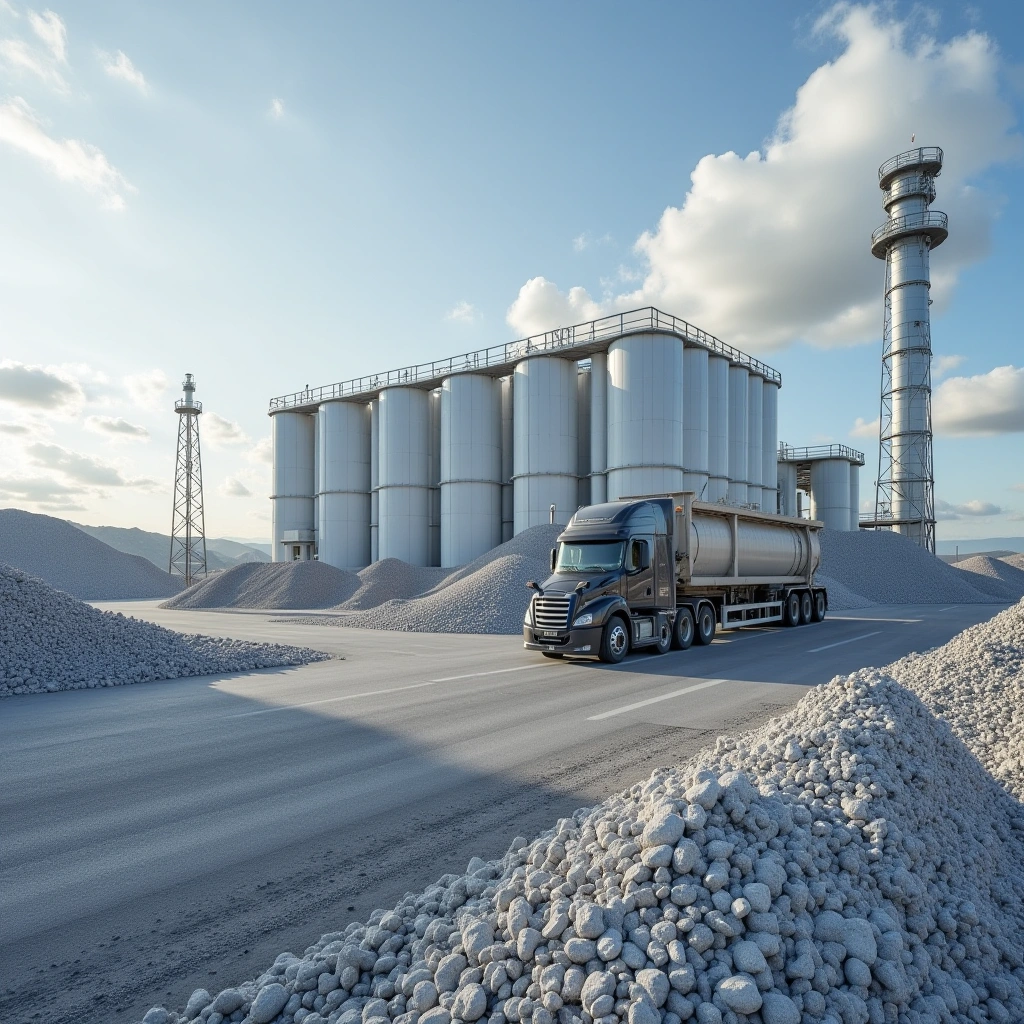
US company Brimstone has developed a process to make cement from carbon-free calcium silicate rocks – which can be found in abundance at the surface of every continent in the world – instead of limestone.
When you think of cement, you probably picture construction workers pouring it into molds or maybe a driveway that’s seen better days. What you probably don’t think about is its potential to help save the planet. Yes, you heard that right! Cement production can actually play a role in removing CO2 from our atmosphere. Let’s dive into this surprising twist in the saga of cement and climate change.
First off, let’s break down the science behind this. Cement production is notorious for being one of the largest sources of CO2 emissions. In fact, it accounts for about 8% of global emissions. Not exactly the best party trick, right? However, researchers have discovered that by integrating direct air capture with a process known as calcium looping, cement can transform from an environmental villain to a semi-hero.
So, what is calcium looping? Well, it’s not as complicated as it sounds. Essentially, this process involves using calcium oxide, which can absorb CO2 from the air. When calcium oxide is heated, it reacts with CO2 to form calcium carbonate. Sounds like chemistry class, doesn’t it? But here’s the kicker: when you heat calcium carbonate again, it releases CO2, which can then be captured and stored or reused. It’s like a never-ending cycle of CO2 capture—who knew cement could be so resourceful?
Now, you might be wondering how this all ties into renewable energy. As renewable energy sources like wind and solar become more efficient and cheaper, the financial viability of integrating these technologies with cement production becomes more appealing. Imagine a world where your new driveway not only looks great but also actively contributes to reducing greenhouse gases. Talk about a conversation starter at your next barbecue!
The financials are key here. With renewable energy generation becoming increasingly affordable, the cost of implementing direct air capture technologies in cement production is likely to drop. This means that companies could soon find themselves not just producing cement, but also making money by capturing CO2. It’s like having your cake and eating it too—except the cake is made of sustainable materials and the icing is a cleaner planet.
Of course, it’s not all sunshine and rainbows. There are still challenges to overcome, such as scaling up these technologies and ensuring they are widely adopted in the cement industry. But hey, Rome wasn’t built in a day, and neither will our new sustainable cement infrastructure be.
In conclusion, while cement has been the butt of many environmental jokes, it’s time to give it a second look. With innovative approaches like calcium looping and the rise of renewable energy, this humble construction material might just help us tackle climate change. Who knew that the stuff under our feet could be a part of the solution? So next time you see a cement truck, maybe give it a little nod of appreciation—after all, it’s working hard to save the planet, one slab at a time.
Inspired by: “Cement production can actually remove CO2 from the atmosphere by integrating direct air capture via…” (r/climatechange)