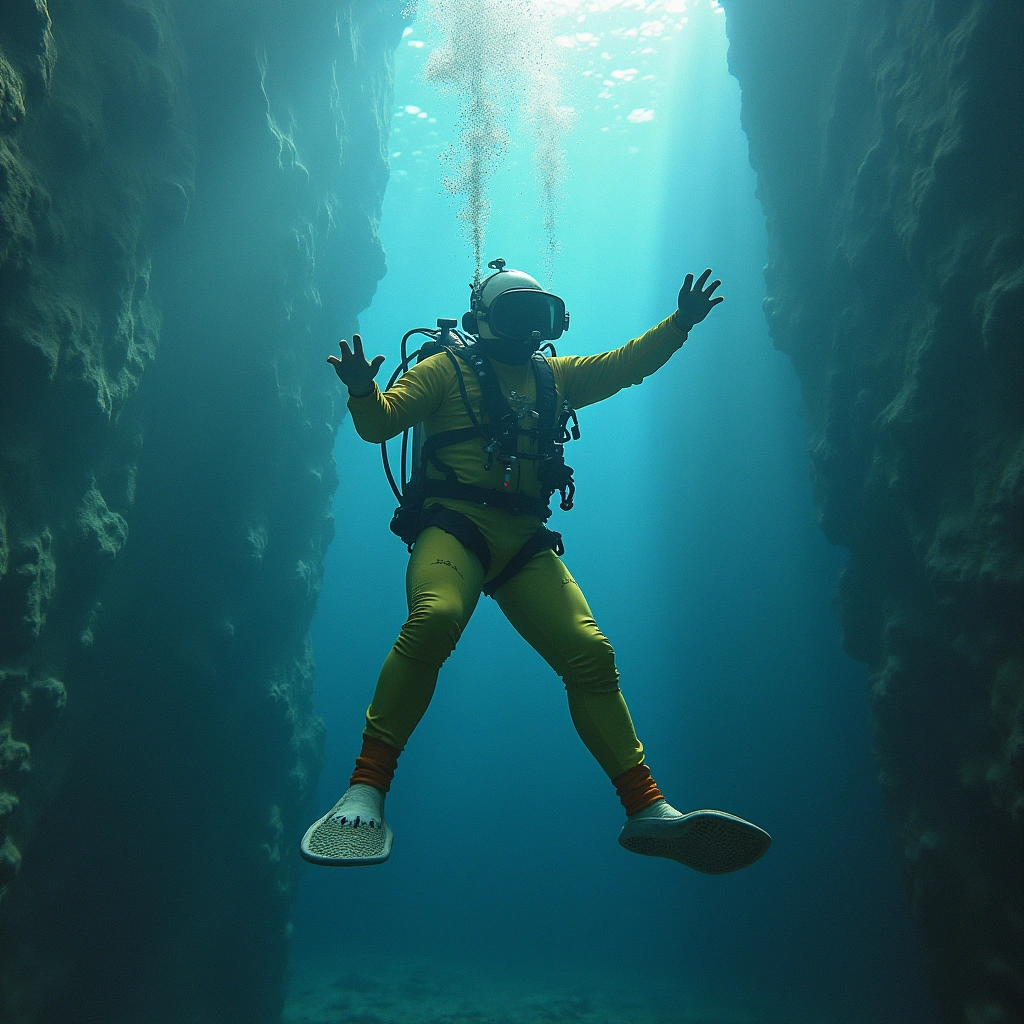
On 17 February, Berry Cannon, a 33-year-old civilian electronics engineer who had served on SEALAB II, began convulsing on the sea floor . His team dragged him back into the capsule.
Ah, the 1960s—a decade of wild experimentation, disco, and a little thing called space exploration. But while everyone was busy launching rockets to the moon, the US Navy had a rather ambitious plan of its own: colonizing the deep blue sea. Enter SEALAB, a project that aimed to prove that humans could live on the ocean floor. Spoiler alert: it didn’t go quite as swimmingly as they had hoped.
It all started in 1965 when President Lyndon Johnson picked up the phone to congratulate aquanaut Scott Carpenter for spending a month living on the ocean floor. Imagine that conversation! “Hey Scott, how’s it down there? Still wearing your snorkel and flip-flops?” Unfortunately, Carpenter’s helium-rich voice made him sound like a cartoon rodent, and the phone operators couldn’t quite make out the conversation. Talk about a killer first impression!
The mastermind behind SEALAB was Navy doctor George Bond, affectionately known as Papa Topside. Now, he had a bit of a conundrum: how do you get divers to stay underwater longer without risking their lives? The answer, as it turns out, was simple—stay down long enough to saturate your tissues, and then you could come up without the lengthy decompression time. Genius! Or, as some might say, a classic case of overthinking a problem that probably didn’t need solving.
The first successful mission, SEALAB I, took place in 1964 off the coast of Bermuda. Four divers lived at around 192 feet for ten days, completing a year’s worth of work in just one week. They were like the overachievers of the ocean, except without the annoying group project dynamics. Fast forward to SEALAB II, which was even bigger and more ambitious. Located off La Jolla, California, this habitat housed three teams of divers for 15 days, with Carpenter himself staying for a whopping 30 days. They even had a trained porpoise named Tuffy who helped ferry gear from the surface. Because who wouldn’t want to work alongside a marine mammal?
But just when you thought the underwater utopia was on the horizon, SEALAB III came along in February 1969 and brought with it a tragic twist. The habitat, rated for a staggering 600 feet, was lowered to the ocean floor and began leaking helium almost immediately. This was not an ideal start. Then, just two days in, tragedy struck. Berry Cannon, a 33-year-old electronics engineer, began convulsing on the sea floor. Despite his team’s best efforts, he was pronounced dead before they could bring him back to the surface. The official cause? Carbon dioxide asphyxiation due to a malfunctioning scrubbing device. Oops.
This incident led to a Navy board of inquiry, which concluded that Cannon’s death was due to an empty baralyme canister. However, many have contested this finding, leaving a cloud of mystery over what really happened down there. And just like that, the dream of underwater colonies began to sink, much like the SEALAB itself.
So what can we learn from the SEALAB saga? Well, for one, maybe living on the ocean floor isn’t as easy as it sounds. And two, if you’re planning to send a bunch of people to live underwater, make sure they have functioning equipment—because no one wants to be the next tragic statistic in the name of science.
In the end, the dream of colonizing the ocean quietly disappeared, leaving us with little more than a quirky story and perhaps a newfound appreciation for our dry, land-loving existence. Who needs underwater colonies when you have Netflix and a comfy couch, right?
So here’s to SEALAB—an ambitious project that, while it didn’t end the way they envisioned, certainly gave us something to talk about while we’re lounging poolside, far from the depths of the ocean. Cheers!
Inspired by: “The SEALAB Saga: When Aquanauts Tried to Make the Ocean Their Home (and Failed Spectacularly)”