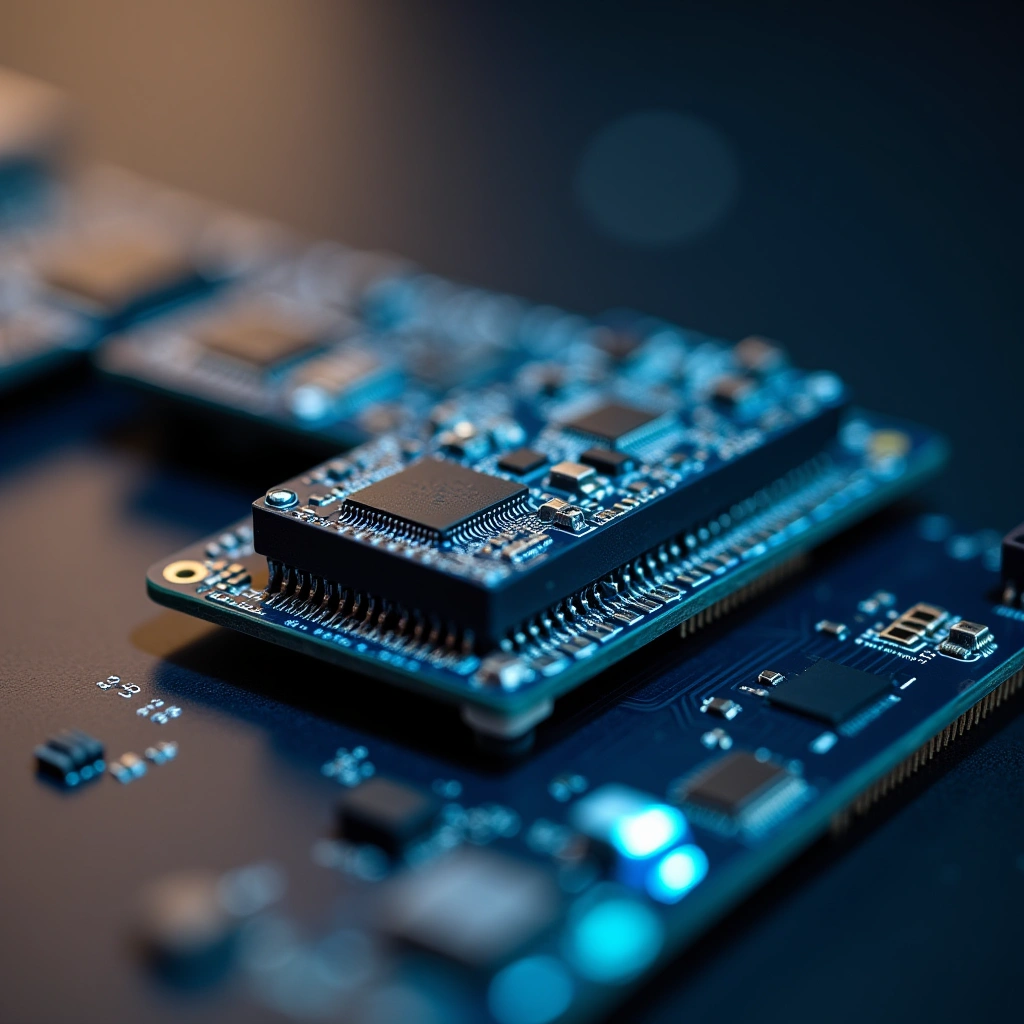
In the ever-evolving world of technology, we often find ourselves in awe of the latest and greatest gadgets, devices, and artificial intelligence breakthroughs. But what happens when an AI developer takes a giant leap forward with a microcontroller that costs less than your average cup of coffee? Enter the $10 ESP32-S3 microcontroller, which has recently been put to the test, running a whopping 28.9 million-parameter AI model. Yes, you heard that right—28.9 million parameters on a device that you could mistake for a fancy remote control!
It's exactly what you think: he got a 28.9-million-parameter language model running locally, entirely on-device, on an ESP32-S3 microcontroller. If you haven't read any of our previous coverage of this tiny chip, ESP32-S3 boards offer about …
Now, before we dive into the nitty-gritty details of how this miracle was achieved, let’s take a moment to appreciate the sheer audacity of running such a complex model on a microcontroller. It’s like trying to fit an entire circus into a clown car—impressive, slightly chaotic, and definitely not something you’d expect to see on your average Tuesday.
The Magic of the ESP32-S3
So, what exactly is the ESP32-S3? It’s a low-cost, low-power microcontroller developed by Espressif Systems, designed for IoT (Internet of Things) applications. With its dual-core processor, integrated Wi-Fi, and Bluetooth capabilities, it’s the Swiss Army knife of microcontrollers. But let’s be honest, when you think of microcontrollers, you probably don’t picture them performing complex AI tasks. More like blinking LEDs or controlling a robotic arm, right?
Enter Google’s Per-Layer Embeddings Technique
The real star of this show is Google’s Per-Layer Embeddings technique. This clever approach allows developers to optimize the storage and performance of large AI models. In layman’s terms, it helps to compress the model so that it can fit into the limited memory of the ESP32-S3, which has a mere 16MB of Flash memory. It’s like putting a whole library into a shoebox—impressive and slightly mind-boggling.
By using this technique, the developer managed to store the essential data required for the AI model without requiring a supercomputer or a data center the size of a football field. Instead, they used a microcontroller that you could easily forget about as it sits on your desk, possibly gathering dust next to your collection of expired batteries.
What Does This Mean for the Future?
The implications of this achievement are significant. It opens up new possibilities for deploying AI in resource-constrained environments. Imagine smart devices that can learn and adapt without needing to constantly connect to the cloud. This could lead to faster responses, lower latency, and, let’s be honest, a pretty neat party trick to show off at your next tech gathering. “Hey, check out my AI running on this tiny chip!” Cue the impressed gasps.
Challenges and Considerations
Of course, it’s not all sunshine and rainbows. Running a 28.9 million-parameter model on a microcontroller comes with its challenges. For one, the processing power of the ESP32-S3 is limited, which means that while the model can run, it might not be the fastest or most efficient. Think of it as a tortoise in a race against a hare—slow and steady might win the race, but it’s going to take a while.
Additionally, developers need to be mindful of power consumption. The last thing you want is your microcontroller to overheat and spontaneously combust while trying to run a complex AI model. That’s a hard pass for most of us.
Conclusion
In conclusion, the feat of running a 28.9 million-parameter AI model on a $10 ESP32-S3 microcontroller is nothing short of extraordinary. It showcases the innovative spirit of developers who are willing to push the boundaries of what’s possible with limited resources. So the next time you’re feeling overwhelmed by the complexities of modern technology, just remember: if a tiny chip can handle a massive AI model, maybe you can tackle that stack of laundry after all. Now, if only the ESP32-S3 could fold it for me, I’d really be impressed!
Inspired by: “AI developer runs 28.9-million-parameter model on $10 ESP32-S3 microcontroller — uses Google’s Per-…” (r/technology)