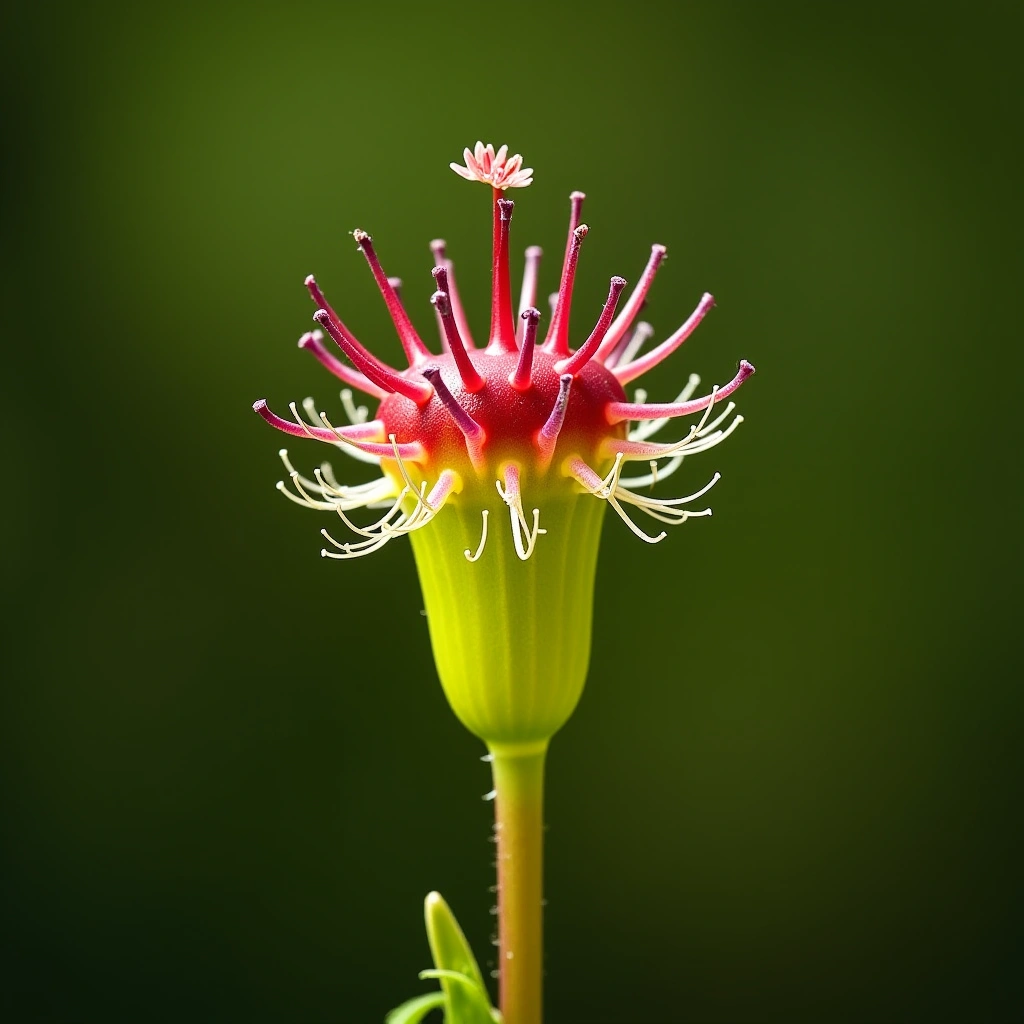
Hey there, fellow plant enthusiasts and curious minds! Have you ever wondered what it would be like to be a plant that dines on delicious, juicy meat instead of boring old leaves? Well, let me introduce you to the fascinating world of carnivorous plants! Spoiler alert: They don’t just take a bite out of your salad—they feast on unsuspecting insects with the flair of a fine-dining establishment!
Related reading: Carnivorous Plant
Now, before you start imagining a plant version of a T-Rex hunting down its prey in your backyard, let’s clear up a common misconception. Carnivorous plants don’t have teeth. They don’t even have mouths! Instead, they have clever adaptations that help them trap their meals. Think of them as nature’s little trapper keepers, but instead of keeping your notes organized, they’re keeping your flies on a one-way trip to flavor town.
One of the most famous among these botanical predators is the Venus flytrap. This green wonder works like a snap-on tool: when an unsuspecting insect lands on its open lobes, the plant closes its traps in less than a second! It’s like a game of whack-a-mole, but with more drama and less annoying arcade music. Once the trap closes, it secretes digestive enzymes to break down its meal. Talk about a plant that knows how to spice things up!
Other carnivorous plants include the pitcher plant, which has leaves shaped like, you guessed it, pitchers. These beauties lure insects in with a sweet nectar and then—oops!—they slide down into a pool of digestive juices. It’s the botanical equivalent of a slippery slide, but instead of ending in a splash, it ends in a stomach. Who knew gardening could be so treacherous?
Now, you might be wondering, why on earth would a plant evolve to eat meat? Well, my friend, it all comes down to survival. Many carnivorous plants thrive in nutrient-poor environments where the soil doesn’t provide enough sustenance. So, they decided to take matters into their own hands—err, leaves! They’ve adapted to catch and digest insects to supplement their nutrient intake. They’re basically the overachievers of the plant world, saying, “Why settle for a salad when you can have a full-course meal?”
But before you go out and start your own carnivorous plant collection, let’s talk about care. These beasts are not your average houseplants. They require specific conditions like high humidity, distilled water (because they’re picky eaters), and plenty of sunlight to thrive. They’re like the divas of the plant kingdom, demanding attention and a prime location in your home. Just remember, if your Venus flytrap starts eyeing your cat, it’s probably time to reconsider your plant choices!
In conclusion, the world of carnivorous plants is as thrilling as it is bizarre. They remind us that nature is full of surprises, and sometimes, it packs a punch—or a snap! So next time you’re in the garden, keep an eye out for these meat-eating marvels. Who knows, you might just catch one in action, and I promise, it will be more entertaining than your last Netflix binge!
Inspired by: “This plant eats meat” (r/interestingasfuck)