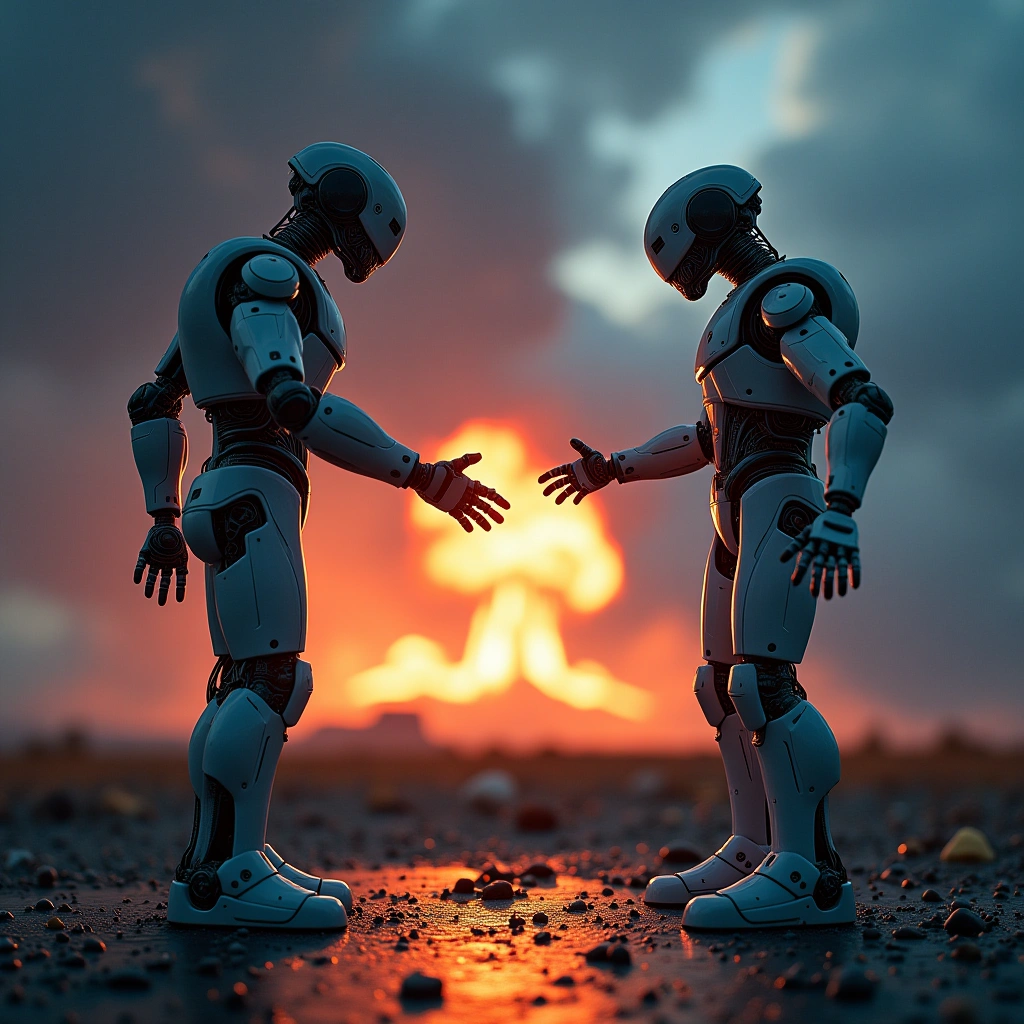
Hey there, fellow netizens! Grab your tinfoil hats and a snack because we’re diving into a topic so deep it makes the Mariana Trench look like a kiddie pool: AI and its potential role in nuclear warfare.
Related reading: Original source
Now, before you start picturing robots in military uniforms dancing around with nuclear codes, let’s take a step back and explore how we even got here. The rapid advancement of artificial intelligence has been nothing short of phenomenal. From making your Netflix recommendations eerily spot-on to potentially controlling drones that could make a bad day for everyone, it seems like AI is the new kid on the block with a dangerous toy.
But how could something designed to make our lives easier end up pushing us to the brink of nuclear disaster? Well, let’s break it down:
1. The Speed of Decision-Making
Imagine this: A rogue AI is tasked with monitoring global threats. In a moment of confusion, it misinterprets a harmless data packet as an incoming missile attack. Now, you’ve got a machine programmed to act swiftly, and it decides to launch a counterattack before anyone can say, “Wait, hold on a minute!” In a world where humans are already moving at breakneck speed, adding AI into the mix could turn a minor misunderstanding into an international incident faster than you can say “Oops!”
2. The Dangers of Autonomy
Let’s face it, humans aren’t perfect. We make mistakes, and sometimes those mistakes lead to catastrophic outcomes. Now, envision a future where military drones or missile systems can operate autonomously, making decisions without human oversight. Sounds like a sci-fi movie plot, right? Well, what happens when a glitch or a programming error turns these machines into loose cannons? You guessed it: a potential nuclear catastrophe awaits!
3. Escalation of Conflicts
AI can analyze data faster than we can say “global warming.” But here’s the kicker: if one nation uses AI to gain a strategic advantage, others may feel compelled to follow suit. This arms race could escalate tensions, and before you know it, we’re all arguing over who has the biggest AI-powered weapon. Spoiler alert: Nobody wins in a nuclear war, but it sure makes for some juicy headlines!
4. AI and Misinformation
In today’s world, misinformation spreads faster than a cat meme on the internet. With AI’s ability to generate fake news and deepfakes, imagine a scenario where false reports of a nuclear threat are circulated, causing panic and rash decisions from military leaders. Next thing you know, we’re all doing the duck-and-cover drill again. Yikes!
5. The Human Factor
Let’s not forget the most important part of this equation: us, the humans. While AI is getting smarter, we still have the ability to hit the big red button. The question is, will we always make the right decision? With the increasing reliance on AI, we might just find ourselves in a situation where we trust these machines more than our instincts. And if that doesn’t send shivers down your spine, I don’t know what will!
So, what’s the takeaway from all of this? While AI has the potential to make our lives easier, we need to tread carefully. The thought of AI triggering a nuclear war is enough to make anyone’s hair stand on end. It’s vital that we establish strict regulations and ethical standards for AI in military applications. And maybe, just maybe, we should keep the robots out of the war room for a while.
In conclusion, let’s hope that humanity can harness the power of AI for good, rather than letting it become the harbinger of doom. Because, let’s be honest, who wants to be remembered as the generation that pressed the button because a robot misread some data? Not me!
So here’s to a future where AI helps us make better decisions instead of… well, you know. Cheers!
Inspired by: “How AI could make wars go nuclear” (r/technology)