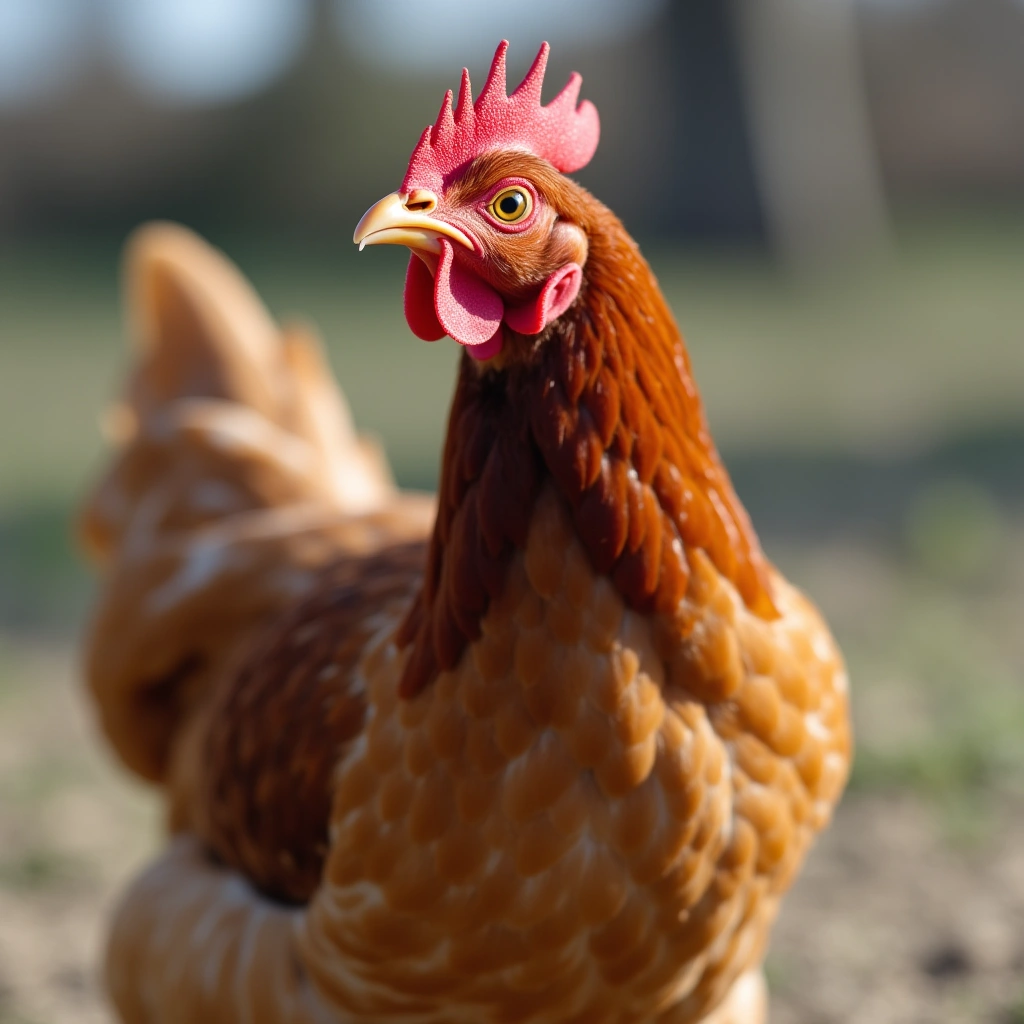
Alright, gather ’round, my fellow camera enthusiasts and poultry aficionados! Let’s take a moment to dive into a topic that’s as juicy as a fried chicken leg: the surprising stability of a chicken’s head compared to a $5,000 camera gimbal. Yep, you heard me right! Buckle up, because this ride is going to be more entertaining than watching a chicken cross the road.
First off, let’s address the elephant in the room—$5,000 for a camera gimbal? That’s a hefty price tag for something that could potentially be outperformed by a creature that’s more concerned with pecking at the ground than balancing your shot! But before you dismiss this idea as pure clucking nonsense, let’s break it down.
Think about it: a chicken’s head is an engineering marvel! As they walk around, their heads stay surprisingly still while their bodies bob around like they’re at a concert. This is due to a phenomenon called the “head stabilization reflex.” Chickens have evolved to keep their noggins steady to avoid looking like a drunk uncle trying to film Thanksgiving dinner. Meanwhile, your fancy gimbal, with all its bells and whistles, might just be a glorified paperweight when you’re trying to capture that perfect shot of a squirrel stealing a nut.
Now, I know what you’re thinking—”But my gimbal has advanced algorithms and fancy motors!” Sure, and so does a chicken… kind of. But let’s not forget that animals have been around for millions of years, honing their skills through evolution while we humans are still figuring out how to use our smartphones without breaking a sweat.
Another point to ponder is the user experience. Ever tried to set up a gimbal? It’s like trying to solve a Rubik’s Cube blindfolded. You have to calibrate it, balance it, and pray to the gods of tech that it works when you hit record. On the other hand, chickens come pre-stabilized! Just set them loose, and voilà—instant head stability without the need for any complicated settings or an instruction manual thicker than a Shakespeare play.
But wait, there’s more! Let’s talk about the versatility. A chicken can roam free, capturing all kinds of angles while pecking at whatever it finds. Your gimbal, however, is stuck in the realm of ‘please don’t drop me’ and ‘don’t even think about using me in the rain.’ In other words, the chicken is living its best life while your gimbal is having an existential crisis.
Now, before you toss your gimbal out the window and run to your local farm for a chicken, remember that there’s a time and place for both. The gimbal is great for those epic cinematic shots—if you can get it to work—and the chicken is perfect for that spontaneous documentary-style footage. But let’s be real: in a chicken vs. gimbal showdown, the chicken is definitely clucking ahead!
So the next time you find yourself wrestling with your high-tech gear, just remember: Sometimes, the simplest solutions are often right under our beaks. Who knew a chicken could outshine a $5,000 camera gimbal? Now, if only we could train them to capture our family vacations…
In conclusion, the humble chicken proves that you don’t need to break the bank to achieve stability. With its natural ability to keep its head steady, it’s clear that sometimes, the best things in life come from the barnyard, not the tech store. Now, let’s cluck our way to better videography!