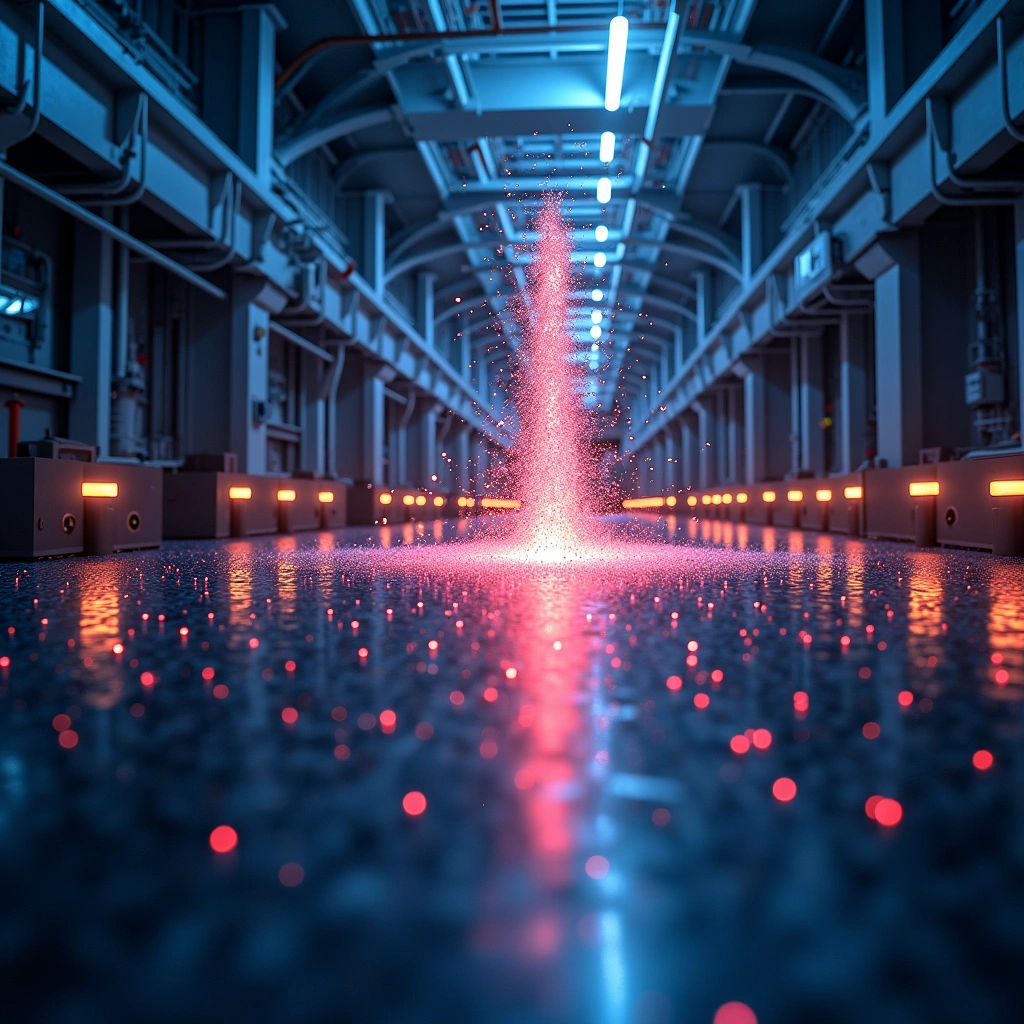

Have you ever heard about the fascinating phenomenon that occurs during a nuclear reactor pulse? It’s a captivating interplay of physics that not only generates power but also creates an awe-inspiring visual spectacle known as Cherenkov radiation. Let’s dive deep into what happens during these reactor bursts and explore the science behind this extraordinary occurrence.
### The Basics of Nuclear Reactor Pulses
At its core, a nuclear reactor pulse is a sudden burst of power produced during a reactor’s operation. It’s akin to a quick surge of energy that can be harnessed for various purposes, from generating electricity to scientific research. These pulses are crucial, especially in experimental reactors, where researchers seek to understand and refine the processes that govern nuclear fission.
One of the most remarkable aspects of these power bursts is how they interact with the surrounding environment, particularly water. You see, in a nuclear reactor, water serves as both a coolant and a neutron moderator, helping to regulate the fission reactions. But when particles reach speeds exceeding that of light in water—approximately 0.75 times the speed of light in a vacuum—they create a stunning phenomenon known as Cherenkov radiation.
### What is Cherenkov Radiation?
Cherenkov radiation is often described as a ‘sonic boom’ of light. This analogy stems from the fact that just as a sonic boom occurs when an object breaks the sound barrier, Cherenkov radiation occurs when charged particles, like electrons, travel faster than the speed of light in a particular medium. In this case, that medium is water.
When these fast-moving particles move through the water, they disturb the electromagnetic field, creating a cascade of photons—particles of light—that emit a characteristic blue glow. This beautiful blue light is what you might have seen in images of nuclear reactors or underwater research facilities.

### The Science Behind the Glow
The phenomenon was first observed by Russian physicist Pavel Cherenkov in 1934 and has since been a pivotal point in nuclear physics. Cherenkov radiation not only visually illustrates the principles of relativity and particle physics but also serves practical purposes. For instance, it’s used in particle detectors to identify high-energy particles and in medical imaging applications.
### Applications Beyond the Reactor
Cherenkov radiation isn’t confined to the walls of a nuclear reactor. Its applications extend far beyond. In the realm of astrophysics, for example, scientists utilize Cherenkov telescopes to detect high-energy gamma rays from cosmic sources. These telescopes observe the Cherenkov light produced by cosmic rays when they interact with the Earth’s atmosphere, providing valuable insights into the universe’s most energetic phenomena.
Moreover, researchers have developed methods to harness this radiation for medical imaging, particularly in cancer treatment. By capitalizing on the properties of Cherenkov radiation, doctors can improve the precision of radiation therapy, ensuring that cancerous cells are targeted while minimizing damage to surrounding healthy tissue.
### Conclusion
In summary, the pulse of a nuclear reactor is not just a technical marvel; it’s a breathtaking display of nature’s laws at work. The creation of Cherenkov radiation during these bursts highlights the intricate dance between particles and the mediums they traverse. As we continue to explore the depths of nuclear physics and its applications, who knows what other stunning phenomena await us? The world of science is an ever-unfolding journey of discovery, and Cherenkov radiation is just one of its many luminous chapters.
So, the next time you think about nuclear reactors, remember the beauty that lies in their power—a radiant burst of light, a testament to the wonders of physics!